一句话亮点
这篇《Cancer Letters》上的文章发现,那些不怕甲硫氨酸剥夺的“甲硫氨酸非依赖”肿瘤细胞,其实是通过维生素B12依赖的MTR酶实现“甲硫氨酸自给自足”。单纯限制甲硫氨酸没用,但加上B12剥夺就能产生协同杀伤,体内实验也证实了这一点。
背景/痛点
甲硫氨酸限制抗癌这事儿,体外和动物模型效果一直不错,但临床上总是不温不火。一个可能的原因是:肿瘤内部的甲硫氨酸依赖性并不均一。有些细胞压根儿不依赖外源甲硫氨酸,被称作“甲硫氨酸非依赖”,它们可能是导致治疗抵抗的元凶。
推理链分步拆解
1. 证实甲硫氨酸非依赖确实存在,且是个普遍现象
作者首先用了几种经典的肺癌和胰腺癌细胞系,确认了确实存在甲硫氨酸依赖(SKLU1, BxPC3)和非依赖(A427, PANC1)的细胞。更有意思的是,他们在两位肺癌患者的原代肿瘤细胞中也观察到了类似差异——一位患者的肿瘤细胞对甲硫氨酸剥夺敏感,另一位则完全不受影响。

Fig. 1. Heterogeneous methionine dependence in cancer cell lines and primary human tumors A-E. Cell proliferation (confluence relative to baseline after cell adhesion) over 5 days under four culture conditions: Hcyst−/Met+ (methionine-supplemented), and Hcyst+/Met− (methionine-free, also called noMet medium), Hcyst−/Met− (negative control), and Hcyst+/Met+ (positive control). Methionine dependence was observed in SKLU1 (A) and BxPC3 (C), while A427 (B) and PANC1 (D) proliferated similarly with or without methionine, indicating methionine independence. E-F. Viability of freshly dissociated lung adenocarcinoma cells from two patients cultured for 3 days under methionine-supplemented (Hcyst−/Met+) or methionine- deprived (Hcyst+/Met−) conditions, assessed by resazurin assay. In patient #1 cancer cells (E), viability was significantly reduced upon methionine deprivation, consistent with methionine dependent subpopulations, while patient #2 cancer cells (F) showed no viability change, consistent with methionine independence. Data are presented with mean ± SD. Statistical significance determined by Student’s t-test. Hcyst: Homocysteine; Met: Methionine; ns: not significant; p < 0.05; p < 0.01; p < 0.001.(图注取自PDF文本层,来源:Cancer Letters, 2026)
@方法论点评:使用原代肿瘤细胞进行验证是这一部分的关键,它表明这种异质性不是细胞系特有的“人工产物”,而是真实存在于临床样本中的现象。这为后续机制探索和联合治疗策略提供了临床相关性基础。
那么问题来了:这些“非依赖”细胞凭什么能在没有外源甲硫氨酸的情况下活得好好的?
2. 找差异基因:非依赖细胞的关键在于B12/MTR通路
作者比较了37个已知依赖/非依赖细胞系的转录组和蛋白质组数据。他们没有直接去找那些“合成甲硫氨酸的酶”本身(比如MTR和BHMT),因为结果发现它们的表达在两组间没差别。
@方法论点评:这是一个非常典型的“靶向差异基因筛查”思路。先看通路层面的整体变化,再聚焦到关键节点,而不是直接去找最直接的代谢酶,避免了先入为主的偏见。
相反,他们发现非依赖细胞中高表达的基因富集在“转录调控”这个功能上。更关键的是,与MTR功能直接相关的两个基因——负责摄取B12的受体CD320和产生MTR底物5-MTHF的酶MTHFR——在非依赖细胞中显著上调。同时,甲硫氨酸转运蛋白SLC43A2表达下调。
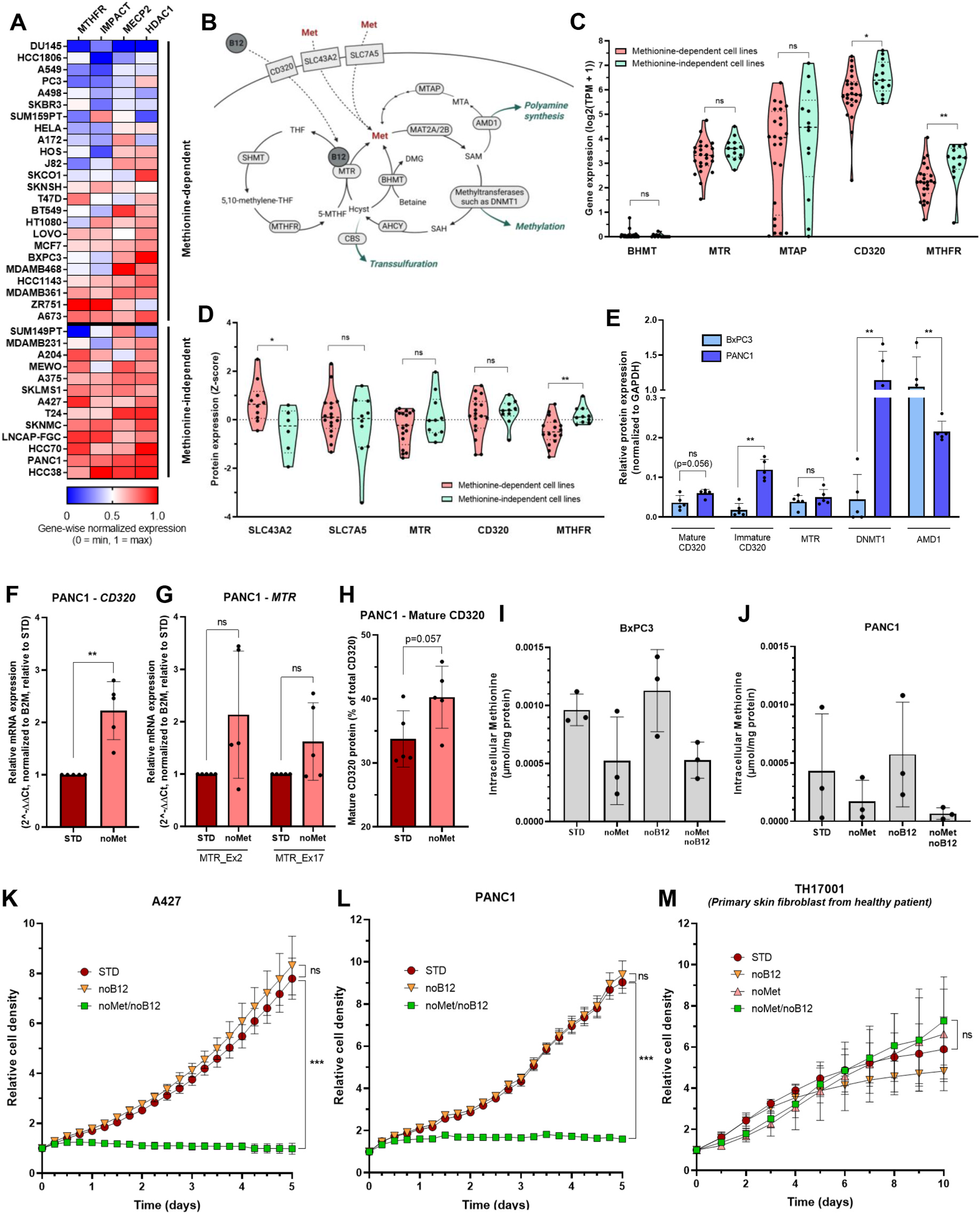
Fig. 2. Methionine-independent cancer cells maintain high methionine demand and rely on B12-dependent endogenous synthesis A. Heatmap of the normalized expression (gene-wise) of 4 selected genes among the top 200 most overexpressed in methionine-independent versus methionine- dependent cell lines, and involved in methylation-based transcriptional regulation (MECP2, HDAC1), folate and homocysteine metabolism (MTHFR), and inhibi tion of amino acid starvation-induced stress (IMPACT). This analysis included 24 methionine-dependent cell lines (A172, A498, A549, A673, BT549, BxPC3, DU145, HCC1143, HCC1806, HeLa, HOS, HT1080, J82, LoVo, MCF7, MDAMB361, MDAMB468, PC3, SKBR3, SKCO1, SKNSH, SUM159PT, T47D, and ZR751) and 13 methionine-independent cell lines (A204, A375, A427, HCC38, HCC70, LNCaP Clone FGC, MDAMB231, MeWo, PANC1, SKLMS1, SKNMC, SUM149PT, and T24). Bulk RNA-sequencing expression data (log2(TPM+1)) were retrieved from the Cancer Cell Line Encyclopedia (CCLE; DepMap Public 25Q2 release). B. Schematic representation of methionine uptake, intracellular synthesis, and downstream use. Abbreviations: 5-MTHF, 5-methyltetrahydrofolate; AHCY, adeno sylhomocysteinase; AMD1, adenosylmethionine decarboxylase 1; B12, vitamin B12; BHMT, betaine-homocysteine methyltransferase; CBS, cystathionine β-synthase; CD320, transcobalamin II receptor; DMG, dimethylglycine; DNMT1, DNA (cytosine-5)-methyltransferase 1; Hcyst, homocysteine; MAT2A/2B, methionine adeno syltransferases 2A/2B; Met, methionine; MTA, 5′-methylthioadenosine; MTAP, methylthioadenosine phosphorylase; MTHFR, methylenetetrahydrofolate reductase; MTR, methionine synthase; SAH, S-adenosylhomocysteine; SAM, S-adenosylmethionine; SHMT, serine hydroxymethyltransferase; SLC43A2 and SLC7A5, amino acid transporters; THF, tetrahydrofolate. C-D. mRNA expression (log2(TPM+1)) (C) and protein abundance (Z-score) (D) for genes involved in methionine synthesis or methionine uptake, with comparisons between methionine-dependent and methionine-independent cell lines. Dots indicate individual cell lines, while dashed lines represent the median (center) and interquartile range (upper and lower). This analysis included the previously listed methionine-dependent and methionine-independent cancer cell lines, restricted to cell lines with available transcriptomic or proteomic data in the corresponding CCLE database. Bulk RNA-sequencing expression data (log2(TPM+1)) were retrieved from the Cancer Cell Line Encyclopedia (CCLE; DepMap Public 25Q2 release) and proteomic data (Z-scores) were obtained from the CCLE-associated Gygi laboratory proteomic dataset. E. Protein expression of key regulators of methionine metabolism in methionine-dependent (BxPC3) and methionine-independent (PANC1) cancer cell lines assessed by Western blot. Relative protein levels of mature and immature CD320, MTR, DNMT1, and AMD1 were quantified and normalized to GAPDH. F-G. RT-qPCR analysis of CD320 (F) and MTR (G) mRNA expression in PANC1 cells under standard (STD) or methionine-deprived (noMet, Hcyst+/Met-) conditions. MTR expression was assessed using two independent exon targets (Ex2 and Ex17). Data are normalized to housekeeping genes and expressed relative to STD. H. Relative proportion of mature CD320 in PANC1 cells under STD or noMet conditions, assessed by Western blot. The mature, fully glycosylated membrane form of CD320 is expressed as a fraction of total CD320 protein (mature + immature intracellular form). I-J. Intracellular methionine levels in BxPC3 (H) and PANC1 (I) cells under STD, noMet, noB12, and noMet/noB12 conditions, measured by HPLC–MS/MS and normalized to total protein content. K-M. Cell proliferation of methionine-independent A427 cells (K), PANC1 cells (L), and primary skin fibroblasts (M) under methionine and/or B12 deprivation conditions. Data are presented with mean ± SD. Statistical significance determined by Student’s t-test. p < 0.05; p < 0.01; p < 0.001; ns: not significant.(图注取自PDF文本层,来源:Cancer Letters, 2026)
这说明啥?非依赖细胞不是“不需要”甲硫氨酸了,而是通过增强“回收利用”能力(上调B12摄取和辅因子供应)来满足自身需求,同时降低对外源摄入的依赖。
3. 功能验证:B12是维持“自给自足”的关键
紧接着,作者在PANC1细胞中验证了这个假设。甲硫氨酸剥夺会上调CD320的转录和蛋白成熟。当把甲硫氨酸和B12同时去掉时,PANC1细胞内的甲硫氨酸水平进一步下降,而单独去掉B12或甲硫氨酸影响都不大。
@方法论点评:这是从“相关”走向“因果”的关键一步。用代谢物水平变化(LC-MS/MS)作为直接证据,比单纯看增殖或活力更有说服力。结果显示,单独剥夺B12在正常培养条件下(有充足甲硫氨酸)不影响细胞内甲硫氨酸水平,说明它的作用依赖于MTR通路。
更重要的是,单独剥夺甲硫氨酸或B12对PANC1细胞的增殖都没什么影响,但两者联合则几乎完全抑制了细胞增殖。这种协同效应在一系列其他类型的非依赖细胞系中都得到了验证。
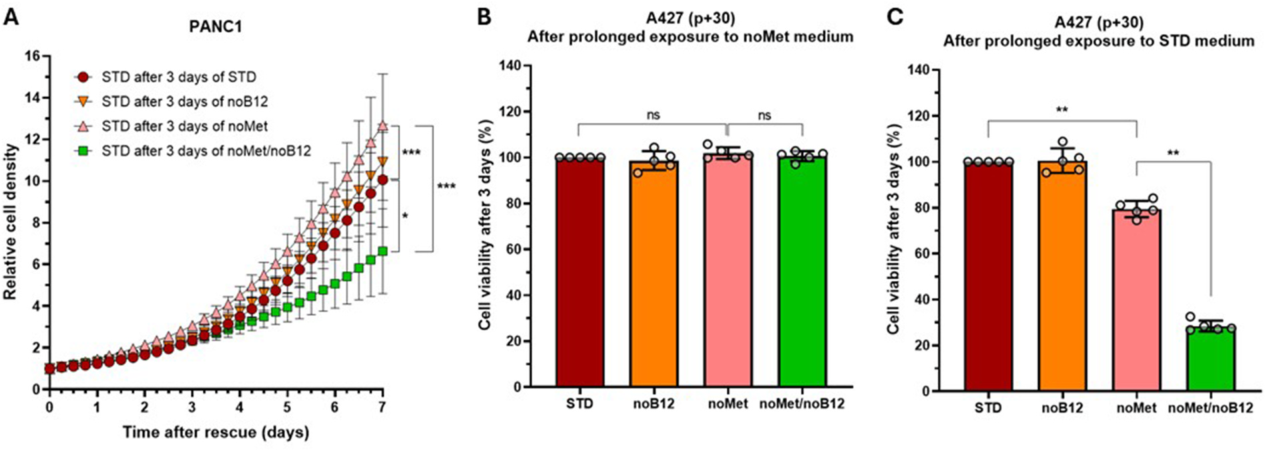
Fig. 3. Combined methionine and B12 deprivation synergistically reduces viability and induces apoptosis in methionine-independent cancer cells A-B. Cell viability of methionine-independent PANC1 (pancreatic carcinoma) cells assessed by resazurin assay after 3 days under: (A) standard condition (STD), methionine deprivation (noMet), B12 deprivation (noB12), or combined deprivation (noMet/noB12); (B) STD or noMet medium, with the addition of siRNA- mediated knockdown of MTR (siMTR) or a non-targeting control siRNA (siCTRL). C. Viability of a panel of methionine-independent cancer cell lines, primary tumor-derived cells, and healthy fibroblasts, after 3 days under the same conditions as in (A), including neuroblastoma SKNMC cells, colorectal adenocarcinoma HT29 cells, lung adenocarcinoma A427 cells, urinary bladder carcinoma T24 cells, pancreatis carcinoma PANC1 cells, melanoma MeWo cells, leiomyosarcoma SKLMS1 cells, surgically resected lung primary adenocarcinoma cells, and primary fibroblast from skin biopsy of healthy female and male donors. D. Representative flow cytometry plots (Annexin V/PI staining) in PANC1 cells and primary fibroblasts after 10 days in STD, noB12, noMet or noMet/noB12 media. Q3: Viable cells (Annexin V−/PI−); Q4: early apoptotic (Annexin V+/PI−); Q2: late apoptotic (Annexin V+/PI+); Q1: necrotic (Annexin V−/PI+). E. Quantification of apoptotic populations in PANC1 cells over time under methionine and/or B12 deprivation. F. Quantification of apoptotic cells (early and late apoptosis) in PANC1 cells after 10 days under standard (STD) or combined methionine and B12 deprivation (noMet/noB12) conditions, with or without the pan-caspase inhibitor emricasan (10 μM) G. Representative flow cytometry plots (Annexin V/PI staining) of PANC1 cells under standard (STD) or combined methionine and B12 deprivation (noMet/noB12) conditions, in the presence or absence of emricasan (10 μM), illustrating the effect of caspase inhibition on apoptosis. H. Quantification of apoptotic and necrotic populations in primary skin fibroblasts from healthy donors after 10 days of methionine and/or B12 deprivation. I. 3D surface plot depicting the δ-score distribution across 36 combinations of methionine and vitamin B12 concentrations, with positive values (red) indicating synergy and negative values (green) antagonism. Cell viability was measured after 3 days of exposure, and synergy was quantified using the ZIP (Zero Interaction Potency) model. Data are presented with mean ± SD. Statistical significance determined by Student’s t-test. p < 0.05; p < 0.01; p < 0.001; ns: not significant; PI: Propidium iodide. (For interpretation of the references to color in this figure legend, the reader is referred to the Web version of this article.)(图注取自PDF文本层,来源:Cancer Letters, 2026)
4. 揭示单纯甲硫氨酸限制的“长期隐患”
既然联合治疗这么好,那之前为什么没人做?或者说,单纯限制甲硫氨酸的临床效果为何不佳?作者设计了一个“治疗-恢复”实验来模拟临床的间歇给药周期。他们先用不同培养基处理PANC1细胞3天,再换回正常培养基。
结果发现,那些预先经历过甲硫氨酸剥夺的细胞,在恢复期出现了“报复性”的增殖反弹,比一直养在正常培养基里的细胞长得还快!更糟的是,如果让A427细胞在甲硫氨酸剥夺条件下长期传代(30代),它们会对后来的甲硫氨酸/B12联合剥夺产生抗性。

Fig. 4. Combined methionine and B12 deprivation prevents rebound growth and metabolic adaptation in methionine-independent cancer cells A. Proliferation of PANC1 cells after 3-day pre-exposure to the four media conditions, followed by rescue in standard medium. B-C. Viability of A427 cells cultured long-term (30 passages) under methionine-deprived (B) or standard (C) conditions, then re-exposed to the four media for 3 days.(图注取自PDF文本层,来源:Cancer Letters, 2026)
@方法论点评:这个“先剥夺再恢复”的设计非常巧妙。它模拟了临床治疗中不可避免的间歇期和停药窗口,揭示了仅依赖单一限制策略可能导致更强的增殖潜力和适应性耐药,为解释临床疗效不佳提供了实验依据。
5. 体内验证:B12拮抗剂+低甲硫氨酸饮食的协同抑瘤作用
解决临床难题的关键一步,就是要有一个能在体内有效拮抗B12的策略。作者合成了B12拮抗剂4-乙基苯基钴胺素(4EP),并通过皮下微渗透泵持续给药,成功抑制了MTR活性(表现为血浆同型半胱氨酸升高)。
在PANC1的荷瘤裸鼠模型中,无论是单独的低甲硫氨酸饮食(0.12%)还是单独使用4EP,对肿瘤生长都没有显著影响。但是,将两者联合起来,则能显著抑制肿瘤生长,且与肿瘤坏死率相关。
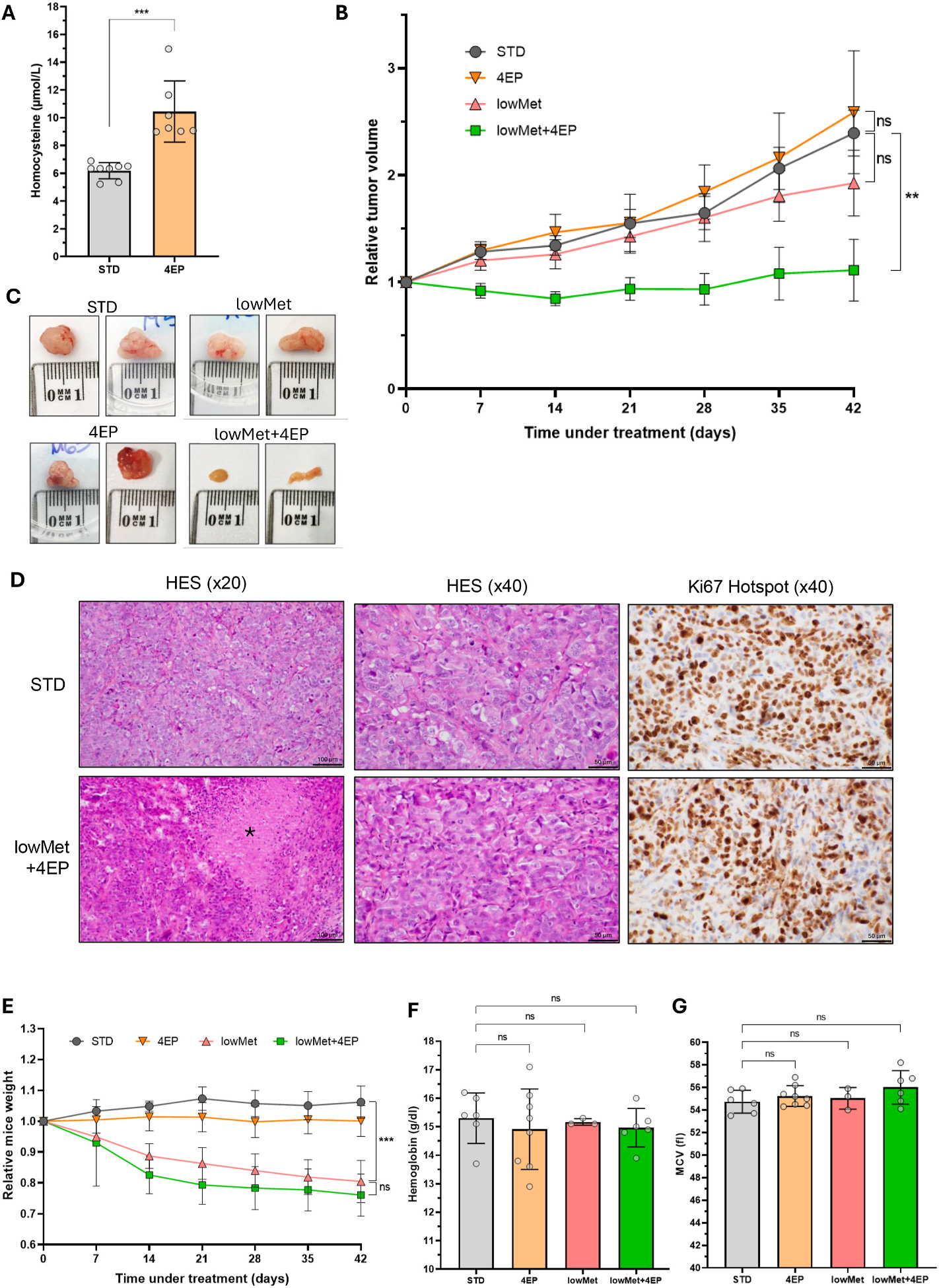
Fig. 5. Synergistic antitumor effect and good tolerability of combined methionine restricted diet and vitamin B12 antagonist in vivo A. Plasma homocysteine levels after 6 weeks of treatment with the vitamin B12 antagonist 4-ethylphenylcobalamin (4 EP, 167.04 nmol/day via subcutaneous osmotic minipumps), compared to vehicle-treated controls under standard diet (STD). B. Tumor growth kinetics (relative tumor volume) under four treatment groups: STD, 4 EP, lowMet (low methionine diet), and lowMet+4 EP. Statistical comparisons referred to comparison of relative tumor volume at day 42 compared to mice of the STD group. C. Representative images of xenografts collected at endpoint, selected near the median tumor weight for each group. D. Histological and immunohistochemical analysis of tumors from the STD and lowMet+4 EP groups. Hematoxylin–eosin–saffron (HES) staining at ×20 (left) and ×40 (middle), and Ki67 immunostaining (right) showing hotspot Ki67 labeling. Asterisks indicate necrotic areas. E. Body weight evolution relative to baseline over time in the four treatment groups. F-G. Hemoglobin levels (F) and mean corpuscular volume (MCV) (G) after 42 days of treatment. Data are presented with mean ± SD. Statistical significance determined by Student’s t-test. p < 0.05; p < 0.01; p < 0.001; ns: not significant.(图注取自PDF文本层,来源:Cancer Letters, 2026)
@方法论点评:体内实验是验证“概念”的关键。使用裸鼠模型排除了T细胞等适应性免疫的干扰,能更纯粹地观察药物对肿瘤细胞本身的直接作用。同时,通过监测体重和血常规,也初步评估了该联合策略在“有效剂量”下的短期安全性。
核心结论
肿瘤细胞对甲硫氨酸的“非依赖”状态,本质上是通过上调B12摄取和利用效率实现的“甲硫氨酸自给自足”。这一代谢特征既是它们在甲硫氨酸限制下“存活”的保障,也是它们新的“阿喀琉斯之踵”:一旦B12/MTR通路被阻断,这种“自给自足”就会变成致命的弱点。将饮食中的甲硫氨酸限制与B12拮抗剂相结合,是一种有前景的、在体内外均有效的协同抗肿瘤策略。
对耐药/DTP/PGCC 的启示
靶向代谢脆弱性:针对这种“自给自足”的代谢表型,可以开发联合用药策略,以清除或抑制在甲硫氨酸限制下存活的耐药细胞亚群。 动态监测生物标志物:血浆B12和同型半胱氨酸水平可作为潜在的临床生物标志物,用于筛选可能从B12/MTR联合治疗中获益的患者群体,并监测其药效动力学效应。 防止适应性耐药:在治疗初期就采用联合剥夺策略(而非单药限制后序贯联合)可能更为关键,这能防止耐药细胞亚群在单药压力下获得“报复性增殖”的能力,避免后续联合治疗的效果大打折扣。
局限
机制未完全阐明:虽然证明了B12拮抗的有效性,但B12剥夺+甲硫氨酸限制协同诱导凋亡的具体信号通路(除了caspase依赖外)有待进一步明确。 体内模型的局限性:使用免疫缺陷的裸鼠,无法评估该疗法对肿瘤微环境中免疫细胞的潜在影响,而这些免疫细胞也高度依赖甲硫氨酸代谢。 安全性评估有限:虽然未观察到血液学毒性,但对于神经系统(也是B12缺乏的主要受累器官)的长期毒性以及非血液系统的安全性,需要专门设计的、更大规模的毒理学研究来评估。
来源
期刊:Cancer Letters,2026。DOI: 10.1016/j.canlet.2026.218723