一句话亮点
5-FU通过抑制胸苷酸合成酶(TS)造成嘧啶核苷酸耗竭,癌细胞被迫通过UCK2补救途径回补UMP,该过程依赖ATP,于是驱动PGC1α-mTOR介导的线粒体新生——这个适应性代谢升级恰好成为靶向弱点,联合Complex I抑制剂可逆转耐药。
背景/痛点
结直肠癌化疗40年来一直是5-FU的天下,FOLFOX/FOLFIRI方案至今仍是基石。然而一个尴尬的事实是:当年加奥沙利铂和伊立替康是经验性的组合,并非基于机制设计。5-FU作为抗代谢药,同时干三件事——掺入DNA、掺入RNA、抑制TS——比单靶点药更难找"帮凶",所以联合策略长期停滞。而80%的癌症死亡与耐药有关,这个矛盾在临床上非常突出。
为什么线粒体值得关注?因为它是代谢应激的调控中枢,而5-FU恰好就是人为制造代谢应激。作者的核心假设是:能扛过5FU打击的细胞,可能在线粒体层面做出了某种适应性调整——而且这种调整本身可能就是弱点。
推理链分步拆解
1. 先看现象:5FU处理后活下来的细胞,线粒体变多了
他们先用HCT116细胞系,在5µM 5FU处理72h后约有40%细胞存活。测线粒体质量——NAO染色、mtDNA拷贝数、TOM20/VDAC2/ETC复合物蛋白表达——全部上升。电镜显示线粒体变长(aspect ratio升高),网络从碎片状变成丝状,融合蛋白OPA1/MFN2上调、分裂蛋白DRP1下调。关键排除了凋亡的干扰:加caspase抑制剂zVAD并不影响线粒体增加,也不释放细胞色素c,MOMP没变化。所以这不是快要死的细胞在"冒烟",而是活下来的细胞主动调整了线粒体网络。
@方法论点评:先用多种正交方法证明同一个表型(NAO、mtDNA、蛋白),然后用多个对照排除凋亡混淆——这是做线粒体表型的入门必修课。值得注意的是他们特别验证了MOMP和BH3 profiling,说明作者很清楚别人会质疑"线粒体变化是不是凋亡前兆"。
这个现象不挑模型:KRAS/TP53/APC各种突变背景的人CRC细胞、鼠类AKP类器官、非CRC的U2OS,全都有类似反应。甚至体内也成立——HCT116异种移植和AKP原位瘤里,5FU处理后TOM20染色都上升了。但正常间质细胞hMSC没有这个反应,提示肿瘤细胞特异的可塑性。
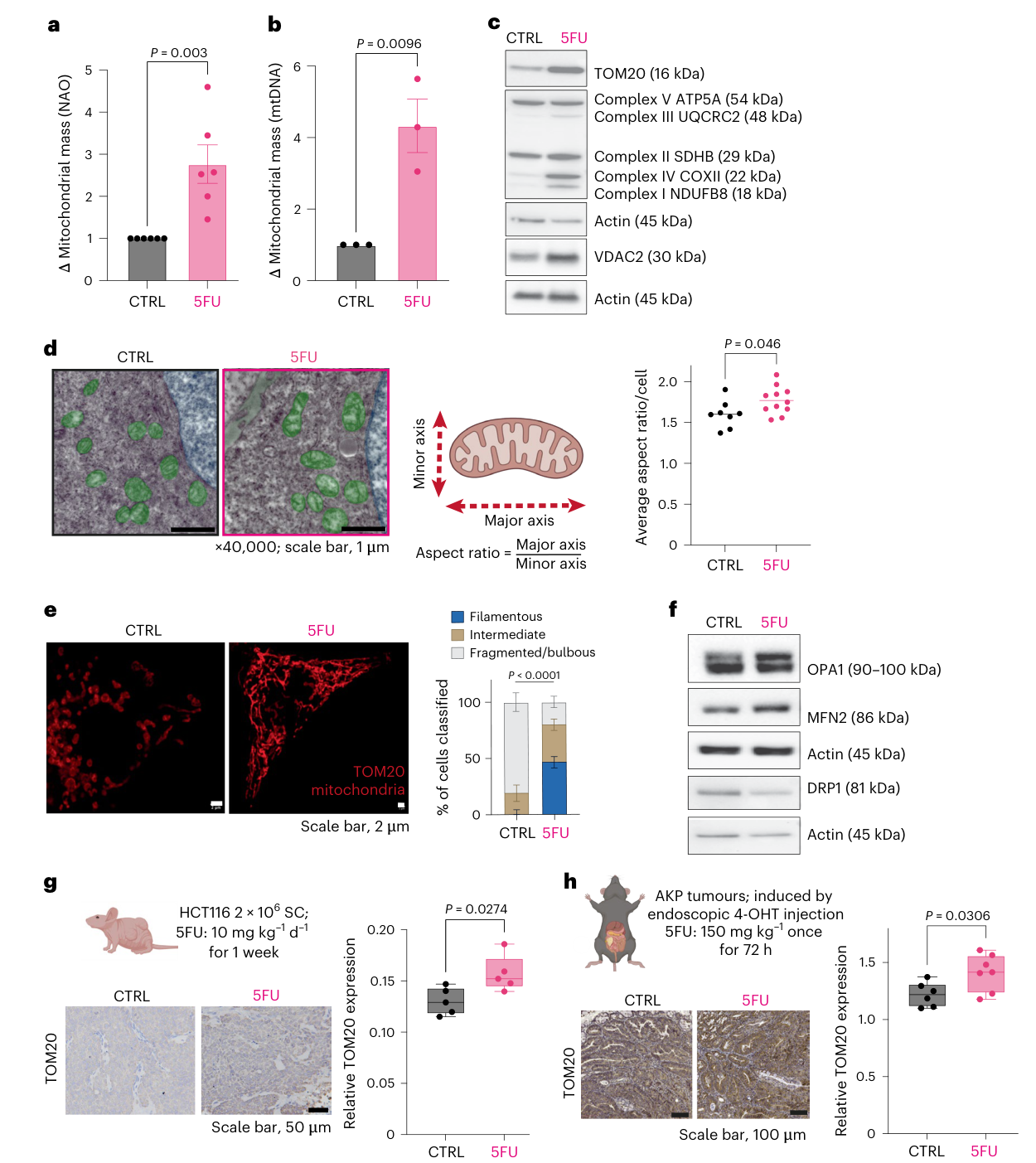
Fig. 1. 5FU treatment drives metabolic adaptation in CRC models. a,b, Mitochondrial mass in HCT116 cells treated with or without 5FU (±5FU) for 72 h, measured by NAO staining (a) or mtDNA content (b). Data points show biological replicates from triplicate means, normalized to mean control (CTRL) from technical replicates. Bars show biological means; error bars, s.e.m. c, Western blot analysis of HCT116 ±5FU (72 h) protein lysates for mitochondrial proteins. Representative blots of n = 5 are shown. d, Transmission electron microscopy images of HCT116 cells ±5FU, with the measurements taken from visible mitochondria to calculate aspect ratio illustrated. Each data point shows the cell mean of all mitochondria per individual cell, with eight cells (CTRL) or 11 cells (5FU) quantified; overall mean shown as line. e, confocal microscopy(图注取自PDF文本层,来源:Nature Metabolism, 2026)
2. 那么问题来了:线粒体变多是好事还是坏事?功能上是亢奋还是崩溃?
如果是单纯"补偿性增生"(功能不足才多造几个),那增生的线粒体应该是残废的。但他们测了Complex I活性——体外活性实验和海马XF都显示CI依赖的耗氧率上升。ATP水平上升。13C₆葡萄糖标记显示TCA循环中间产物(α-酮戊二酸、苹果酸)的标记比例增加,说明TCA flux确实增强了。靶向代谢组学显示72h时一大批代谢物丰度暴涨(PCA第一主成分直接把两组劈开)。转录组层面,RNA-seq显示代谢相关基因大量上调。
@方法论点评:功能验证是区分"增生"和"亢奋"的唯一途径。CI活性+OCR+ATP+同位素示踪,这套组合拳把线粒体功能从酶活、实时呼吸、终产物、碳流四个层面都锁死了。
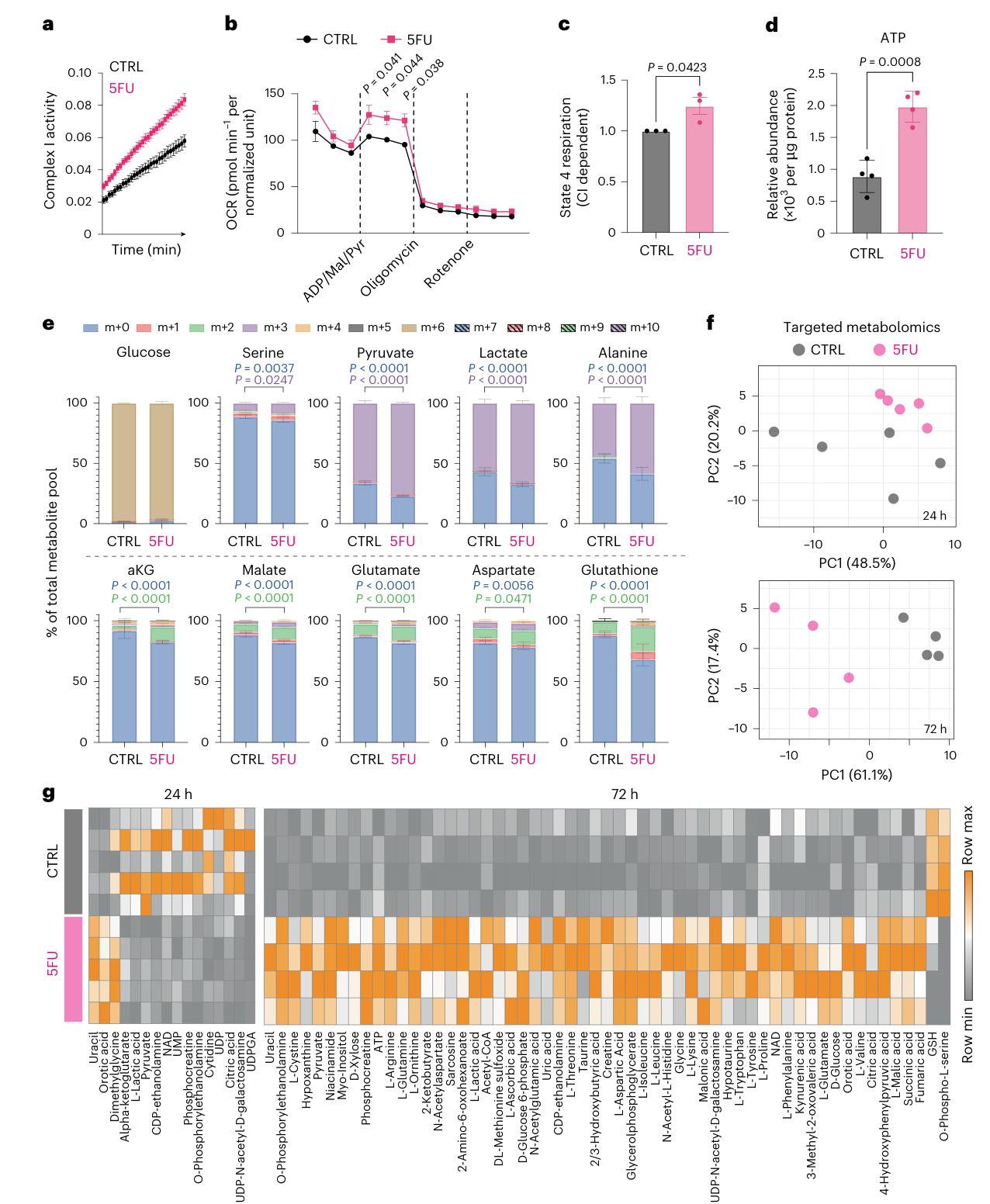
Fig. 2. 5FU treatment reprograms metabolic activity. a, CI kinetic activity assay in HCT116 cells treated ±5FU. Data points show the mean of technical replicates; error bars, s.d. Representative data are shown from three independent experiments. b,c, OCR measured by extracellular flux analysis in cells treated ±5FU for 72 h, at baseline, post CI substrates (ADP/malate/pyruvate), post oligomycin and post rotenone (b), with CI-dependent respiration calculated (c). Data show biological mean ± s.e.m. of n = 3 (b) or individual biological replicates as data points with mean ± s.e.m. d, Quantification of relative ATP abundance by LC–MS in cells treated ±5FU for 72 h. Data show technical replicates; mean ± s.d. e, LC–MS metabolomics analysis of labelling in metabolites downstream(图注取自PDF文本层,来源:Nature Metabolism, 2026)
3. 是什么触发了这个线粒体新生程序?
他们用siRNA敲低TS(TYMS基因)——哪怕不加5FU,仅敲低TS就足以增加线粒体质量。用另一个TS抑制剂雷替曲塞(直接结合TS,不需要代谢活化)处理,同样看到线粒体增加。说明这个信号是TS被抑制本身驱动的,而不是5FU的DNA/RNA掺入效应。
那么TS抑制如何连上线粒体?作者查了mTORC1通路——雷帕霉素和Torin1都能阻断5FU诱导的线粒体新生。PGC1α蛋白随时间递增,AMP/ATP比值在24h和72h的变化不支持AMPK主导(AMPK上升发生在24h,但线粒体质量持续升高到72h),所以是mTORC1-PGC1α这条轴在主导。
@方法论点评:用两种不同机制的TS抑制剂(5FU需要代谢活化,雷替曲塞直接结合)做交叉验证,排除了5FU非特异性效应。用抑制剂而非敲除做通路验证,时间窗口更可控,但后面又用siRNA做因果验证——互为补充,严谨度到位。
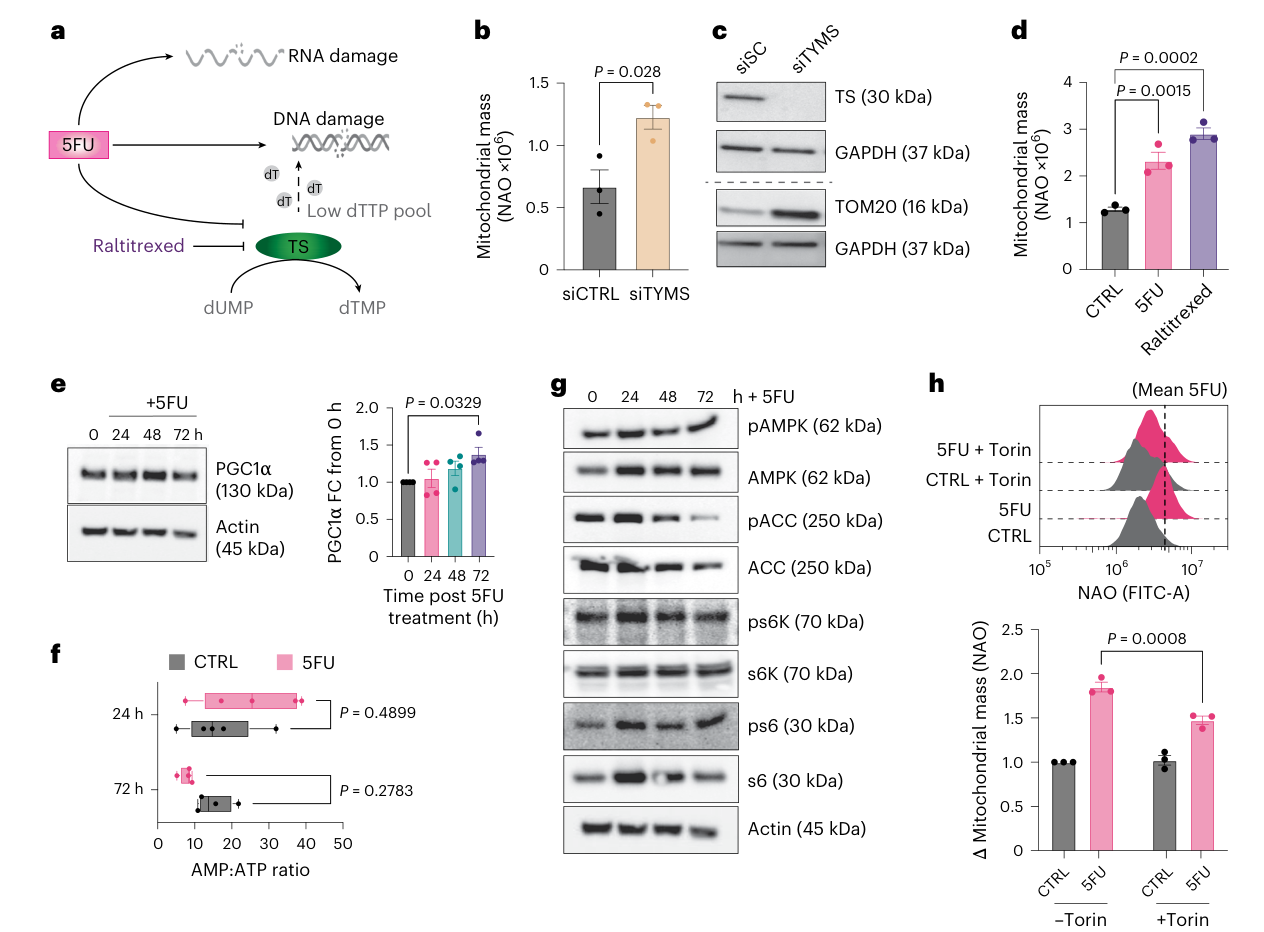
Fig. 3. 5FU treatment increases mitochondrial mass via TS inhibition and mTORC1 signalling. a, Schematic showing impact of 5FU and raltitrexed treatment. b,c, Mitochondrial mass assessed by NAO staining (b, n = 3 biological replicates; mean ± s.e.m.) or TOM20 expression in protein lysates (c) from HCT116 cells transfected with siRNA against CTRL or TYMS. Representative blots of n = 3 shown. d, NAO staining (n = 3 biological replicates; mean ± s.e.m.) of mitochondrial mass in cells treated with 5FU or raltitrexed for 72 h. e, PGC1α expression in protein lysates from cells treated ± 5FU over 72 h relative to actin loading control. Representative blots of n = 4 shown, with four replicates quantified by densitometry; mean ± s.e.m. FC, fold change. f, AMP:ATP(图注取自PDF文本层,来源:Nature Metabolism, 2026)
4. 线粒体功能强的人,是不是对5FU更不敏感?
这里有三个层面的证据:
CRISPR筛选:用GeCKO v1文库在5FU压力下筛选11天,终点富集的基因中OxPhos基因显著富集。MAGeCKflute鉴定出的"增敏基因"(敲除后细胞对5FU更敏感)里,STRING网络分析显示嘧啶代谢和ETC(CI、CV)紧密聚类。
ETC抑制剂:联用5FU + CI/II/III/IV抑制剂,ETC抑制剂的IC₅₀全部下降——也就是说,有5FU在场时,细胞对ETC功能更依赖。反之,在半乳糖培养基里(迫使细胞依赖氧化磷酸化),细胞对5FU的耐受性提高了约2.5倍。过表达NDI1(提升NAD⁺再生和线粒体呼吸)也能增强5FU耐受。
线粒体缺陷模型:用143B线粒体胞杂种(mtDNA突变导致CI和CIV缺陷),这些突变细胞对5FU更敏感。野生型细胞5FU处理后线粒体质量上升,突变细胞虽然也尝试增加线粒体但幅度明显受限,且更易死亡。
@方法论点评:CRISPR筛选无偏见地指出了OxPhos,然后用gain-of-function(NDI1 OE、galactose)和loss-of-function(ETC抑制剂、mtDNA突变株)双向验证——三个独立证据链汇交于同一个结论,这是因果论证的黄金标准。
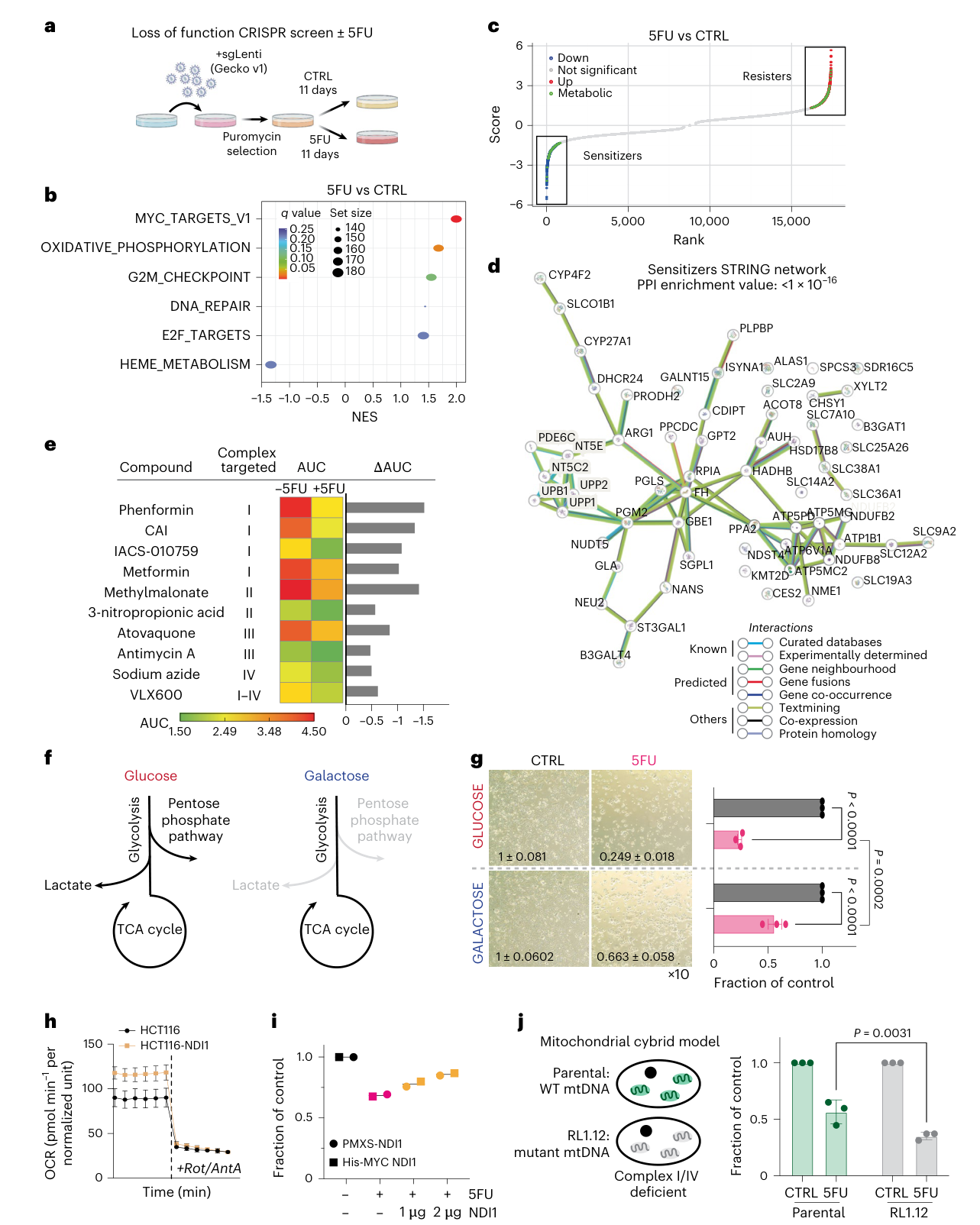
Fig. 5. Mitochondrial metabolism dictates sensitivity to 5FU. a, Schematic representing experimental protocol for CRISPR screening with 5FU in HCT116 cells. b, GSEA analysis of MAGeCK RRA input. c, Sensitizers (blue) and resisters (red) identified by MAGeCKflute Cutoff Calling, with metabolic genes indicated in green. d, STRING network analysis of sensitizers with protein–protein interaction (PPI) enrichment indicated. e, AUC of mitochondrial ETC inhibitors in cells treated ±5FU at 72 h, with complex targeted detailed, and change in AUC (ΔAUC, +5FU – 5FU) shown. f, Schematic representing metabolic change imposed by culturing cells in galactose. g, Representative images and quantification (n = 3 biological replicates; mean ± s.e.m.) of cells cultured in glucose or galactose(图注取自PDF文本层,来源:Nature Metabolism, 2026)
5. 那线粒体亢奋究竟在帮细胞干什么?
5FU抑制TS,造成dUMP堆积和dTTP耗竭。但作者发现:细胞内5FU浓度持续升高,TS的"band shift"(代表三元复合物形成)持续存在,说明TS抑制从头到尾没解除。然而dUMP的堆积在72h反而比24h下降了(虽然仍高于对照)。与此同时,UMP、UDP、UTP在24h时暴跌,到72h居然恢复了。TS还在被抑制,尿嘧啶核苷酸却回补了——这暗示存在一个不依赖从头合成的补救途径。
UCK2(尿苷激酶2)负责将尿苷磷酸化为UMP,这个反应消耗ATP。5FU处理后UCK2蛋白表达随时间上升,而从头合成途径的DHODH蛋白没有变化,OMP/乳清酸也无显著改变。敲低UCK2能阻断5FU诱导的线粒体新生。补充外源性尿苷——解除UCK2的底物压力——同样能阻断线粒体新生。用DHODH抑制剂BAY-2402234(阻断从头合成)也能诱导UCK2上调和线粒体新生,且同样被尿苷逆转。
故事连起来了:TS被抑制 → UMP池枯竭 → 细胞启动UCK2补救途径 → UCK2消耗ATP → 激活mTORC1-PGC1α线粒体新生 → 产生更多ATP支撑UCK2继续工作,直到UMP池恢复平衡。
@方法论点评:最精彩的推理链在于"为什么72h核苷酸恢复了但TS还抑制着"这个悖论——他们抓住这个矛盾一路挖下去,用补充尿苷做"解救"实验,证明了线粒体新生的目的就是支持嘧啶补救。这个"耗竭→补救→回补"的逻辑闭环非常完整。
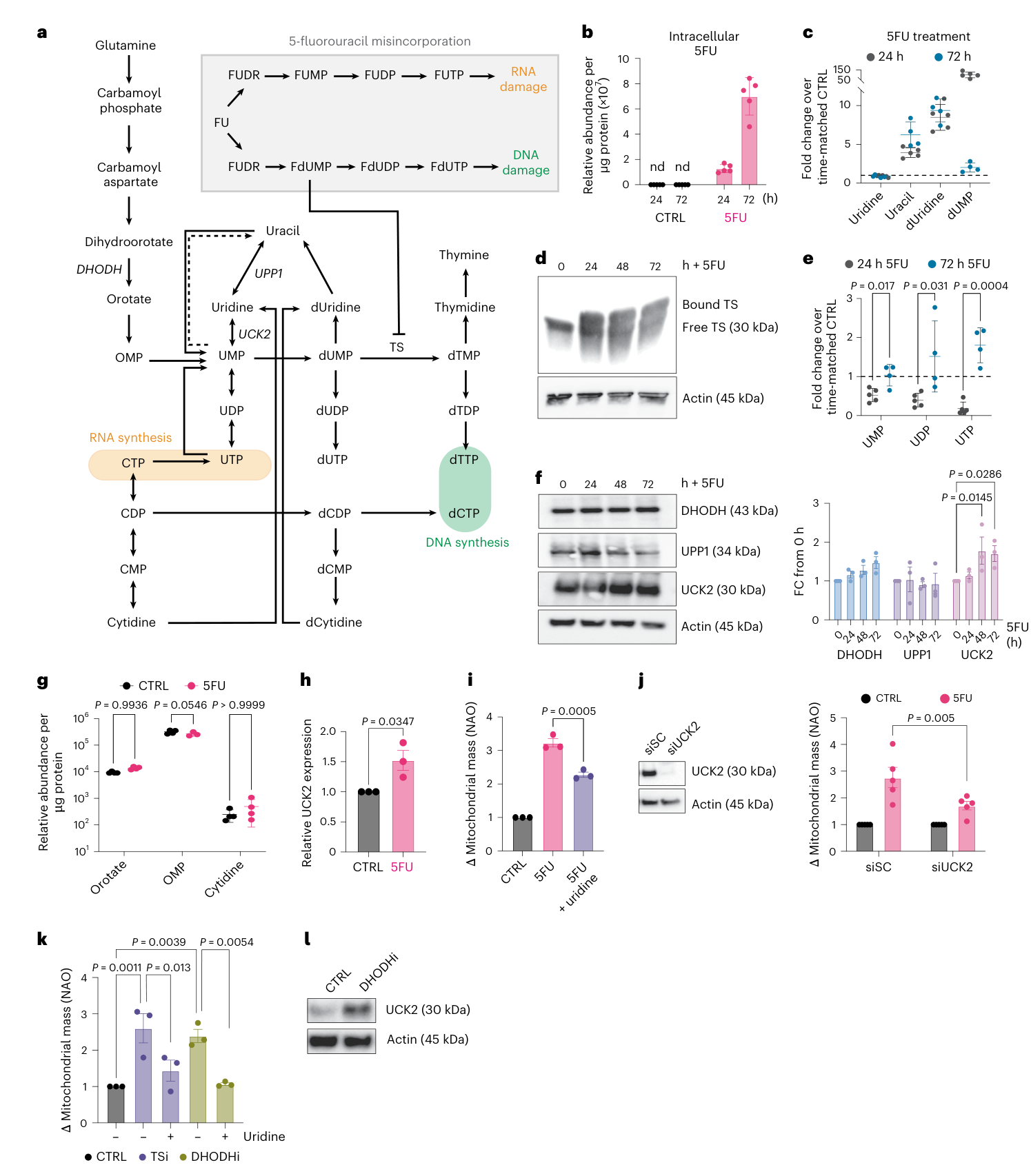
Fig. 8. Metabolic adaptation rebalances 5FU-driven nucleotide stress. a, Schematic representing nucleotide biosynthesis and impact of 5FU. b, Relative intracellular abundance of 5FU by LC–MS quantification of HCT116 cells treated ±5FU; nd, not detected. Values are mean ± s.d. of technical replicates. c, Fold change in intracellular metabolite abundance over time-matched control at 24 h (black) and 72 h (blue) post 5FU treatment. Data show technical replicates, with mean ± s.d. denoted. d, TS expression and band shift in protein lysates from HCT116 cells treated ±5FU over time; representative blot of n = 4 experiments. e, Fold change in intracellular nucleotide abundance over time-matched control at 24 h (black) and 72 h (blue) post 5FU treatment. Data show technical replicates, with mean ± s.d. denoted. f, Protein expression in lysates from HCT116 cells treated ±5FU over time, as previously analysed in Fig. 3g. Representative actin blot is shown; densitometry from n = 3 experiments is presented as mean ± s.e.m.(图注取自PDF文本层,来源:Nature Metabolism, 2026)
6. 最后回到临床:联合CI抑制剂能不能增强疗效?
体内实验选择二甲双胍作为CI抑制剂(因为IACS-010759有神经毒性,苯乙双胍有乳酸酸中毒风险)。HCT116异种移植中,5FU单药有轻微抑制、二甲双胍单药无效,但两者联用从第5天开始显著抑制肿瘤生长。AKP原位瘤模型中,联用组CC3(cleaved caspase-3)阳性细胞比例显著升高。生存实验中,联用组中位生存期显著延长,HR=0.3330。
更重要的是,二甲双胍处理阻断了5FU诱导的TOM20上调——说明它不是在别处瞎搅和,而是精准地切断了这个适应性线粒体新生。而TCGA临床数据分析(Taxonomy队列)显示,OxPhos signature高的患者,接受5FU辅助化疗后反而预后更差——这正好对应"线粒体功能越强,对5FU越不敏感"的机制。
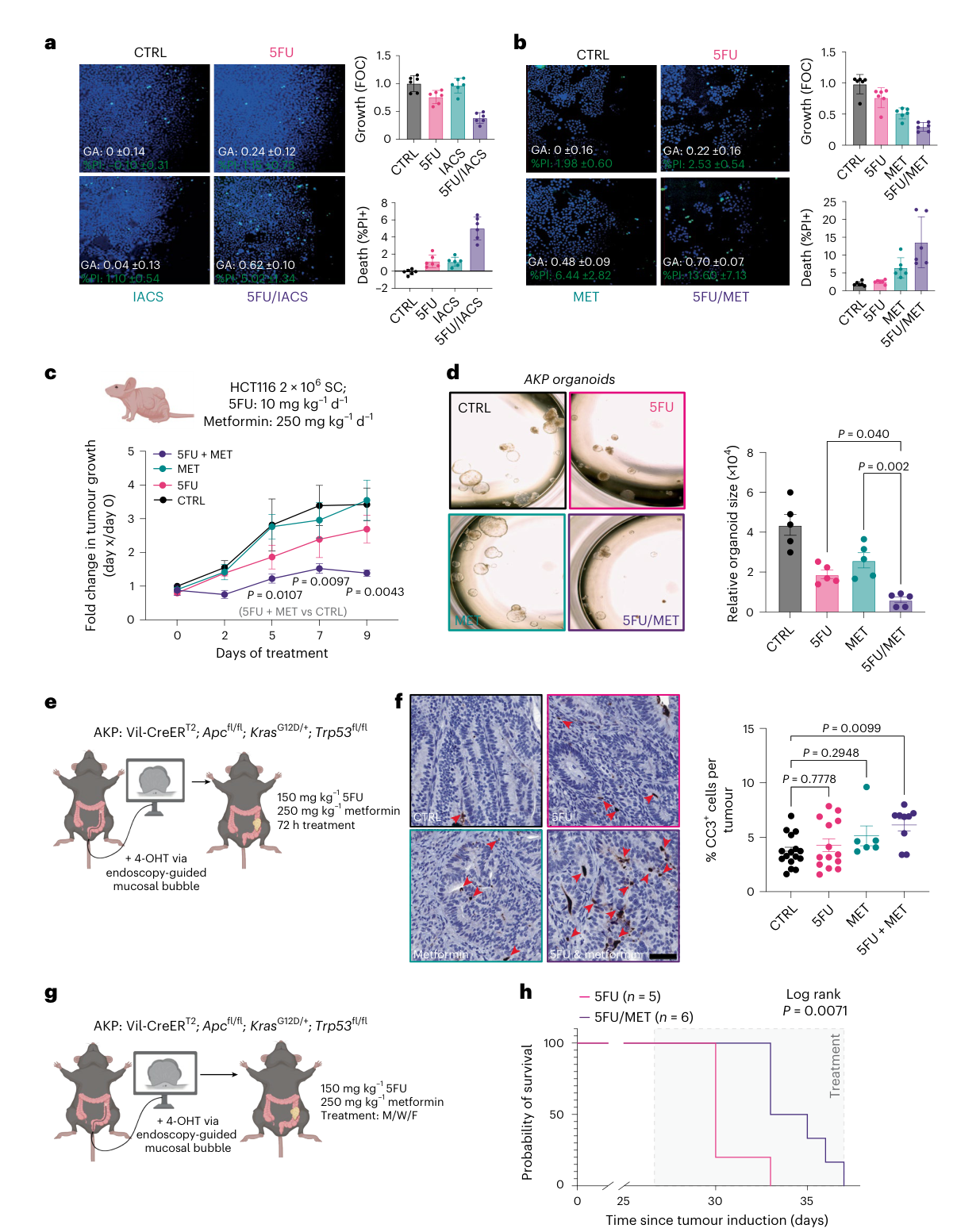
Fig. 6. Inhibiting mitochondrial metabolism increases 5FU efficacy. a,b, High- content images (magnification, ×10) from HCT116 cells stained with Hoechst 33342 (blue) and propidium iodide (PI; green) following treatment ±5FU and ±CI inhibitors IACS-010759 (IACS; a) or metformin hydrochloride (MET; b) for 72 h. Change in growth (number of Hoechst-positive cells relative to vehicle control and media-only control) and death (% PI-positive cells relative to vehicle control) are shown; data points show technical replicates ± s.d., with mean growth arrest (1 − growth FOC (fraction of control)) and mean % PI-positive ± s.d. denoted. c, HCT116 subcutaneous xenograft growth over time in mice treated with PBS (CTRL), 5FU, metformin or 5FU + metformin combination, with tumour growth normalized to day 0. Data points show mean tumour volume per group ± s.e.m. at each timepoint (n = 4 or 5 animals per group). d, AKP organoids treated as indicated with 5 μM 5FU and/or 3 mM metformin for 72 h. Representative images (magnification, ×4) and quantification of relative organoid size are shown.(图注取自PDF文本层,来源:Nature Metabolism, 2026)
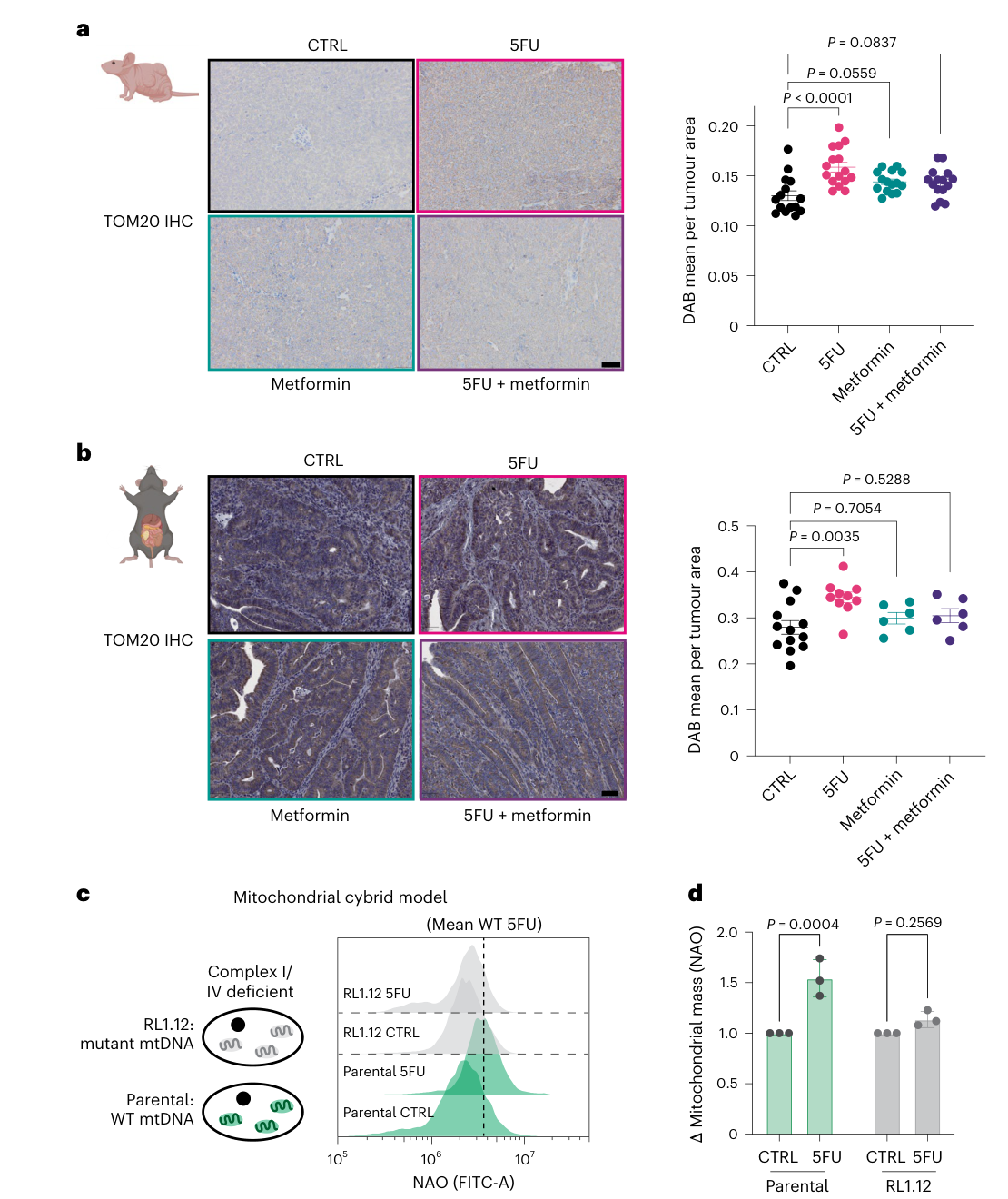
Fig. 7. Inhibiting mitochondrial metabolism blunts 5FU-driven mitochondrial biogenesis. a,b, Relative mean intensity of TOM20 staining of HCT116 xenografts (a, from Fig. 6c) or AKP tumours (b, from Fig. 6e) per tumour area measured. Scale bar, 50 μm. c,d, Mitochondrial mass by NAO staining in WT mtDNA (parental) and mutant mtDNA (RL1.12) cybrid cells ±5FU, with representative(图注取自PDF文本层,来源:Nature Metabolism, 2026)
核心结论
5FU耐药的关键适应性机制是:TS抑制 → 嘧啶核苷酸耗竭 → UCK2补救途径超负荷运转 → ATP需求激增 → mTORC1-PGC1α驱动线粒体新生 → 增强的OxPhos支撑补救途径直到嘧啶库回补。这个线粒体"军备竞赛"恰好制造了可靶向的脆弱性——联合CI抑制剂(二甲双胍)阻断这一代偿,即可显著增强5FU疗效,延长生存。
对耐药/DTP/PGCC 的启示
药物耐受持久细胞(DTP)的代谢重塑画像:本研究发现急性5FU存活细胞的线粒体生物合成和融合在72h内完成,提示DTP状态的建立可能比预想中更快——不是"缓慢适应",而是几天内的主动代谢重编程。这对DTP的早期捕获和干预窗口提出了新视角。 线粒体并不是越弱越敏感:与某些化疗中"线粒体功能障碍增强药物敏感性"的逻辑不同,本文揭示线粒体功能亢进恰恰是生存策略的一部分。提示在耐药逆转策略中,不能笼统地"抑制线粒体",而要区分"功能亢进型代偿"与"功能障碍型崩溃"。 PGCC可能的代谢特征:文中虽未直接涉及PGCC,但线粒体融合增加(OPA1上调、DRP1下调)与已知的PGCC形成过程中的线粒体动态变化有重叠。若PGCC也依赖UCK2-mTORC1线粒体新生通路应对嘧啶应激,二甲双胍联合治疗或对PGCC介导的复发有抑制作用,值得探索。
局限
临床部分使用公共数据回顾性分析,OxPhos signature与预后的关联性仍需前瞻性队列验证。 二甲双胍作为CI抑制剂在体内存在多效性,虽然体外用多种CI抑制剂和遗传模型交叉验证了机制,但体内效应不完全排除二甲双胍的其他作用(如肠道菌群、免疫调节)。 急性适应(72h)与长期获得性耐药的机制衔接尚不完整——文中提到慢性耐药的类器官线粒体表型类似,但中间过渡状态的动态演化路径未做详细追踪。
来源
期刊:Nature Metabolism,2026。DOI: 10.1038/s42255-026-01578-w。