一句话亮点
这篇《Advanced Science》研究发现,m6A 阅读器 YTHDC1 在 TNBC 中特异性高表达,它像一位"代谢指挥家":一手稳定 GLUT3 mRNA 保糖供 NADPH,一手降解 ATF4 mRNA 抑制 SLC7A11 防胱氨酸超载;敲低 YTHDC1 则同时断糖并释放 SLC7A11,触发双硫死亡;而绕过 YTHDC1 直接递送 ATF4 mRNA,则能分别配合 GLUT 或 GLS 抑制剂,主动将 TNBC 推向代谢崩溃。
背景/痛点
三阴性乳腺癌(TNBC)恶性度高、易复发,靶向治疗选择有限。癌症细胞代谢可塑性极强,堵一条路,它立马绕道,单药效果往往不理想。因此,寻找能"按住多个代谢开关"的枢纽分子,是 TNBC 治疗的重要方向。
m6A 修饰是 RNA 上最丰富的修饰,其阅读器(Reader)能同时调控一群 mRNA 的命运。但这么多阅读器,哪个在 TNBC 里最关键?它们具体在代谢网络中"按住"了哪些开关?搞清楚这些,才可能找到高效又相对特异的干预靶点。
推理链分步拆解
Step 1:YTHDC1 为何值得看——从患者数据到代谢表型
作者并没有直接扑向某个明星代谢基因,而是先问了一个根本问题:10 个主要 m6A 调控因子里,谁跟 TNBC 患者预后最相关?通过 Kaplan-Meier 分析,他们锁定 YTHDC1 和 FTO。但 CPTAC 蛋白数据发现,只有 YTHDC1 在肿瘤中显著高表达,且在 TNBC 亚型中更高。
接着他们在 TNBC 细胞系中敲低 YTHDC1,发现细胞增殖受抑、死亡增加。通过 RNA-seq、m6A-seq 和 YTHDC1 RIP-seq 三组学交叉,鉴定出 347 个高置信度的 m6A 依赖靶基因,GO 富集直指"细胞代谢过程"。代谢组学也证实,YTHDC1 敲低后,糖酵解、磷酸戊糖途径(PPP)、谷氨酸代谢通路均受影响。
@方法论点评:从临床预后→亚型特异性→表型筛选→多组学交叉,层层收窄,逻辑非常清晰。三组学交叉(RNA-seq + m6A-seq + RIP-seq)是确定"m6A 依赖的直接靶标"的黄金组合,能有效区分直接调控与间接效应。
那 YTHDC1 具体在代谢网络里"按住"了哪个关键节点呢?
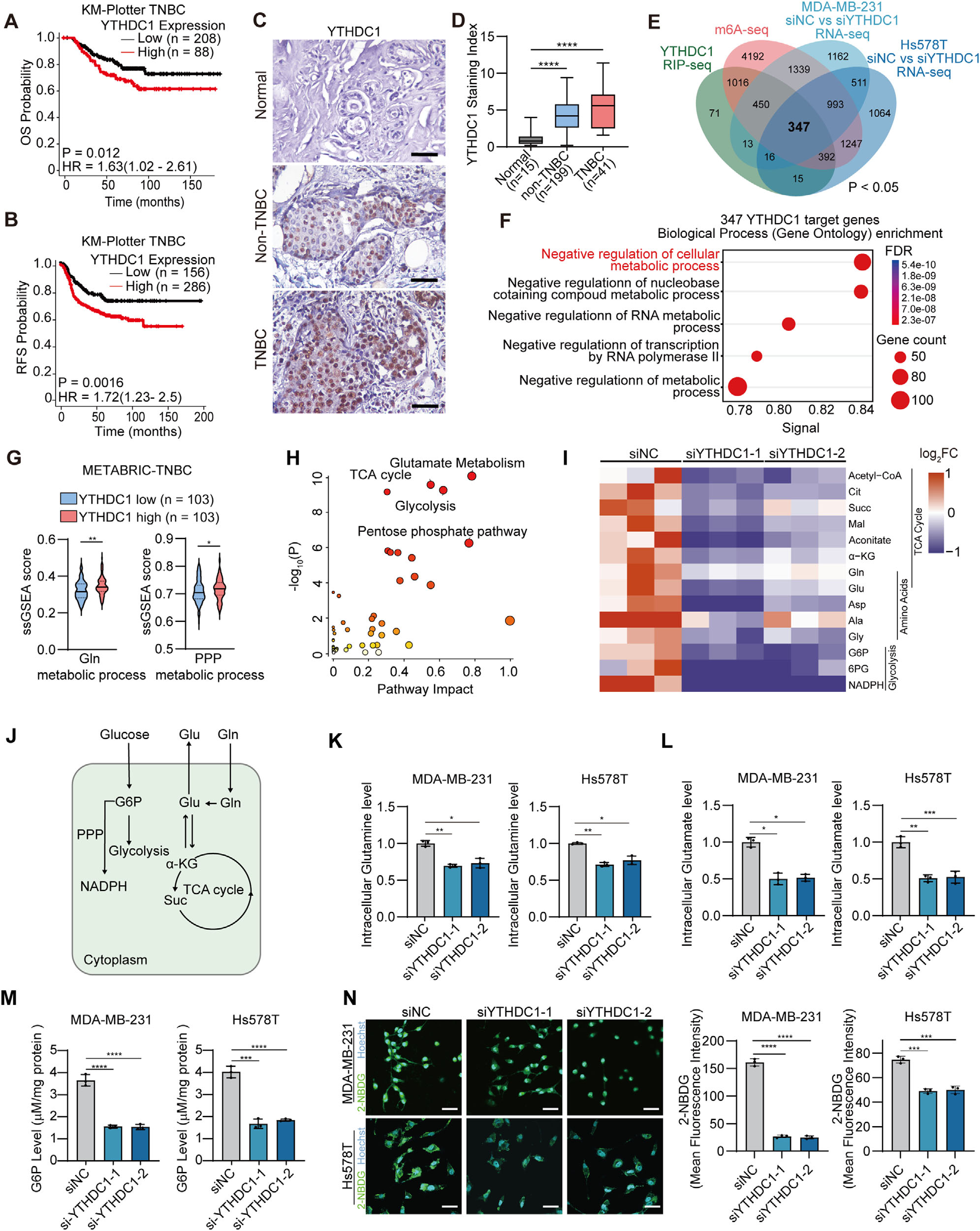
Fig. 1. YTHDC1 rewires glucose and glutamine metabolism in TNBC. (A,B) Survival analysis of TNBC patients from Kaplan–Meier plotter database reveals that high expression of YTHDC1 is significantly associated with poorer overall survival (OS) (A) and progression-free survival (PFS) (B). (C,D) Immunohistochemistry of YTHDC1 in tissue microarray (TMA) reveals that expression of YTHDC1 in TNBC is significantly higher than in non-TNBC and normal tissue. Scale bars, 20 µm. (E) Venn diagram analysis integrating RNA-seq (MDA-MB-231and Hs578T), m6A-seq (MDA-MB-231), and YTHDC1 RIP-seq (MDA-MB-231) data identifies 347 protein-coding genes as high-confidence m6A-dependent targets of YTHDC1. Hypergeometric testing confirms that the three-way intersection is highly significant ( p < 0.05). (F) Gene Ontology (GO) analysis of the 347 candidate genes from (D) reveals significant enrichment in cellular metabolic process. (G) TNBC samples with high YTHDC1 expression exhibit higher ssGSEA scores of glutamine (Gln) metabolism and pentose phosphate pathways (PPP) signature compared to those with low YTHDC1 expression in METABRIC-TNBC(图注取自PDF文本层,来源:Advanced Science, 2026)
Step 2:抓住两个关键靶基因——GLUT3 与 ATF4
既然 YTHDC1 影响葡萄糖和谷氨酰胺代谢,作者便从代谢通路中倒推靶基因。在葡萄糖通路中,他们筛出 GLUT3(葡萄糖转运蛋白);在谷氨酸通路中,筛出 ATF4(SLC7A11 的转录因子)。
RNA-seq 轨迹图显示,敲低 YTHDC1 后,GLUT3 下降,ATF4 却上升——一正一反,相当有趣。RIP-qPCR 和 m6A-RIP-qPCR 确认 YTHDC1 直接结合 ATF4 和 GLUT3 mRNA,且二者均有 m6A 修饰。mRNA 稳定性实验表明:YTHDC1 缩短 ATF4 半衰期(抑制其表达),但延长 GLUT3 半衰期(促进其表达)。
@方法论点评:这里用mRNA 半衰期实验区分了"转录调控"与"转录后调控",说明 YTHDC1 的作用是影响 mRNA 稳定性,而非转录水平。这是证明 m6A 阅读器直接功能的关键证据。
为了证明这一切真的依赖 m6A 识别能力,作者构建了 YTHDC1 的两个 m6A 结合位点突变体(W377A、W428A)。突变体无法结合 ATF4 和 GLUT3 mRNA,也无法回补代谢和表型缺陷。进一步点突变 ATF4 和 GLUT3 的 m6A 位点(A→G),同样阻断了 YTHDC1 的结合和调控。
@方法论点评:“功能丧失突变 + 回补实验"是证明"该功能确由 m6A 识别介导"的严苛标准。如果没有这一步,只能说明 YTHDC1 调控这两个基因,不能说明依赖 m6A。
那 YTHDC1 同时压低 ATF4、抬高 GLUT3,最终是为了什么?
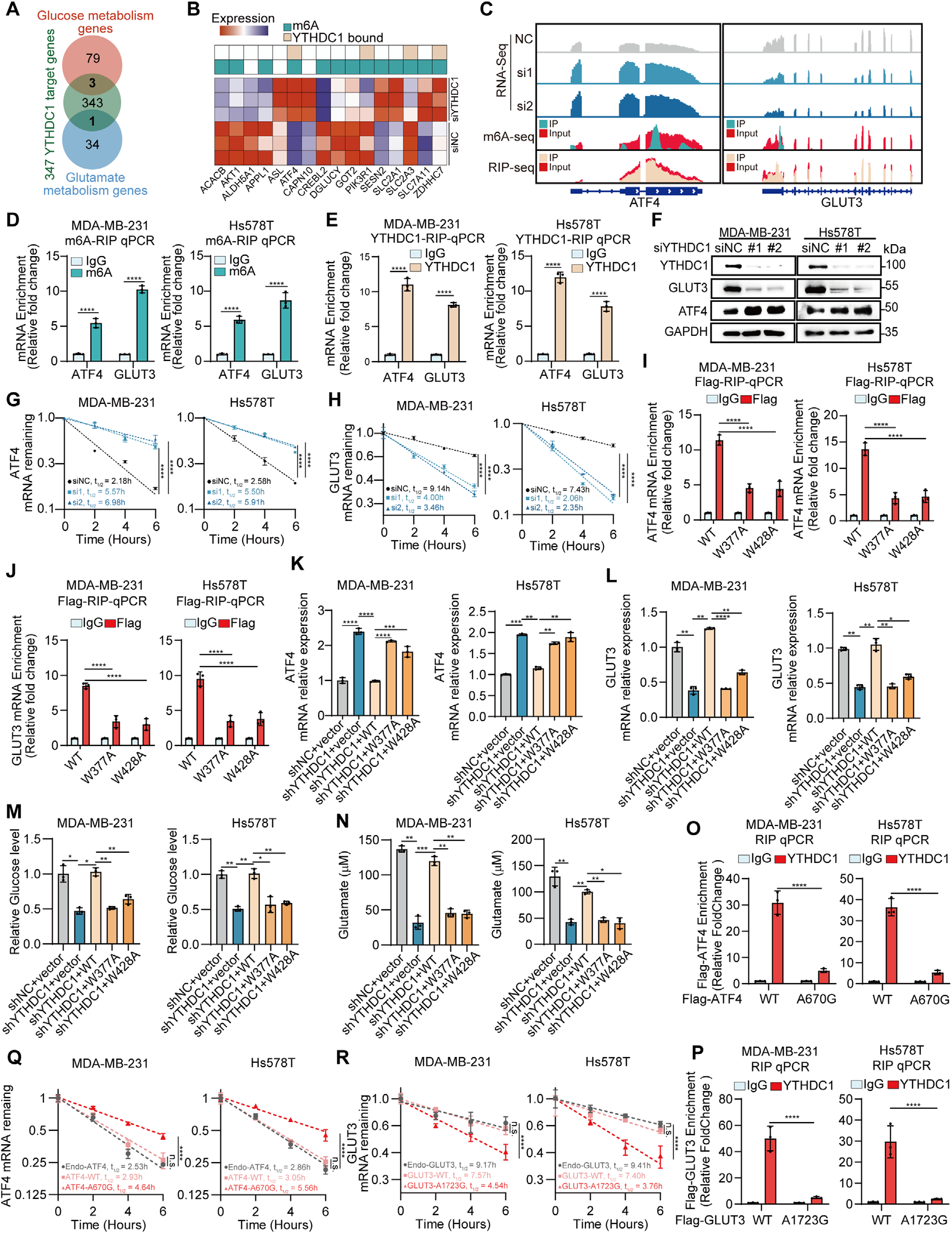
Fig. 2. YTHDC1 regulates ATF4 and GLUT3 mRNA in an m6A-dependent manner to coordinate TNBC metabolism. (A,B) Overlap of YTHDC1 target genes with genes in the glucose and glutamine pathways. (C) Representative tracks of RNA-seq, m6A RIP-seq, and YTHDC1 RIP-seq at the ATF4 and GLUT3 loci in control versus YTHDC1 KD MDA-MB-231 cells, demonstrating YTHDC1 binding, m6A modification, and transcript abundance changes. (D) m6A RIP followed by RT-qPCR showing m6A enrichment on ATF4 and GLUT3 transcripts in TNBC cells. (E) YTHDC1 RIP followed by RT-qPCR in TNBC cells validates the binding of ATF4 and GLUT3 mRNAs to YTHDC1. (F) Western blot analysis of ATF4 and GLUT3 protein levels in TNBC cells upon YTHDC1 KD. (G) YTHDC1 KD increases ATF4 mRNA stability. (H) YTHDC1 KD decreases the stability of GLUT3 mRNA. (I,J) RIP-qPCR in TNBC cells overexpressing Flag-tagged WT or mutant YTHDC1 shows that YTHDC1 W377A and W428A mutations abolish the binding to ATF4 (I) and GLUT3 (J) mRNAs. (K,L) WT YTHDC1, but not the W377A and W428A mutants rescue the mRNA expression of ATF4 (K) and GLUT3(图注取自PDF文本层,来源:Advanced Science, 2026)
Step 3:YTHDC1 如何"防爆”——防止双硫死亡
ATF4 是 SLC7A11 的主要转录因子。YTHDC1 敲低后,ATF4 上升,SLC7A11 随之升高。SLC7A11 是胱氨酸/谷氨酸反向转运体:进口胱氨酸,出口谷氨酸。
那这个变化会产生什么后果?作者用同位素示踪(13C6^{13}C_613C6-葡萄糖和13C5^{13}C_513C5-谷氨酰胺)精确追踪代谢流:YTHDC1 敲低后,葡萄糖摄取及进入 PPP 的通量下降,导致 NADPH 减少;同时,SLC7A11 高表达导致胱氨酸大量涌入,细胞内胱氨酸堆积,而谷氨酸被大量泵出胞外。NADPH 本是用来还原胱氨酸为半胱氨酸的"还原力",现在 NADPH 告急,胱氨酸堆积,就引发了双硫死亡——肌动蛋白骨架异常二硫键交联,细胞收缩、F-actin 聚集。
@方法论点评:同位素示踪是"代谢流"研究的金标准,它能告诉你"代谢物从哪来、到哪去",比单纯测代谢物浓度深刻得多。细胞收缩 + F-actin 聚集 + 非还原胶迁移滞后,三者共同构成双硫死亡的表型证据链。
有意思的是,YTHDC1 敲低造成的葡萄糖通路与谷氨酸通路的变化,是平行独立的,而非补偿关系。分别剥夺谷氨酰胺或葡萄糖,YTHDC1 敲低都会额外加重伤害。
@方法论点评:这里通过代谢物剥夺实验 + 交叉检测来检验两条通路的关系,证明了它们是两条平行轨道而非"此消彼长"的网络。这种设计对于理解枢纽分子的调控架构非常关键。
那么,敲低 YTHDC1 触发的双硫死亡,在小鼠身上能复现吗?
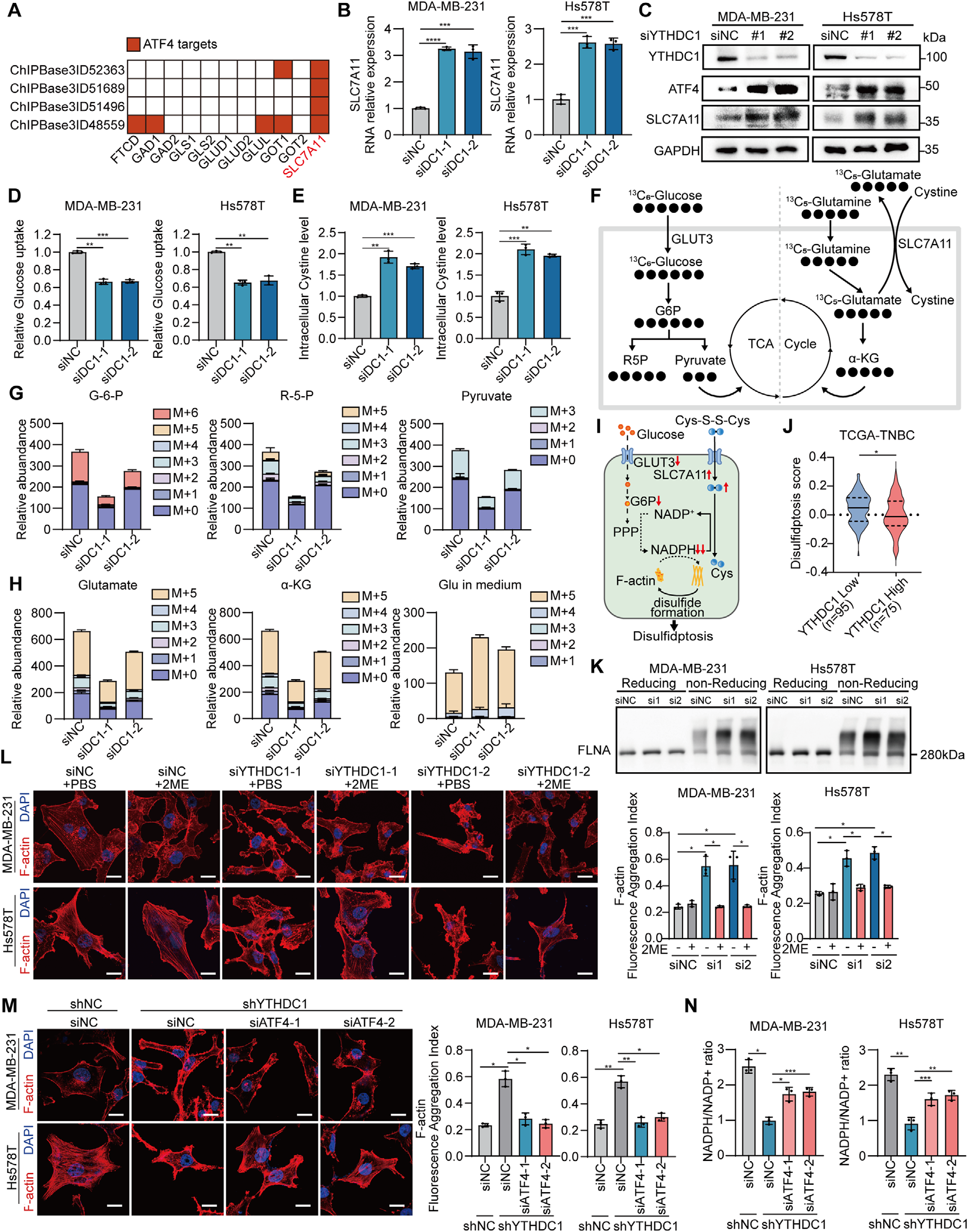
Fig. 3. YTHDC1 knockdown induces disulfidptosis through ATF4-mediated transcriptional upregulation of SLC7A11. (A) SLC7A11 is identified as a direct transcriptional target of ATF4 across multiple independent datasets in ChIPbase. (B,C) YTHDC1 knockdown in TNBC cells increases SLC7A11 expression at the (B) mRNA level and (C) protein level. (D,E) YTHDC1 knockdown decreases glucose uptake (D) and elevates intracellular cystine (E) in TNBC cells. (F) Schematic diagram of 1 3 C5 -glutamine or 1 3 C6 -glucose isotope tracing experiments followed by mass spectrometry in MDA-MB-231 cells. (G) YTHDC1 knockdown significantly reduced the abundance of 1 3 C-labeled glucose-6-phosphate (G-6-P), ribose- 5-phosphate (R-5-P), and pyruvate, compared with siNC cells. (H) YTHDC1 knockdown caused a marked reduction in intracellular 1 3 C-labeled α-ketoglutarate ( α-KG). Concomitantly, the abundance of 1 3 C-labeled glutamate in the culture medium was significantly elevated. (I) A schematic diagram illustrating that upregulated SLC7A11 and downregulated GLUT3 together lead to disulfidptosis. (J) TNBC samples with low YTHDC1 expression(图注取自PDF文本层,来源:Advanced Science, 2026)
Step 4:体内验证——YTHDC1 是 TNBC 应对代谢压力的"保险丝"
作者在裸鼠上建立了 Tet-on 诱导敲低的 MDA-MB-231 原位瘤模型。YTHDC1 敲低后,肿瘤生长显著受抑,ATF4/SLC7A11 上升、GLUT3 下降,葡萄糖↓、胱氨酸↑、NADPH/NADP⁺↓、谷氨酸↓、ATP↓,F-actin 聚集增加,Ki67 下降。所有体外代谢和双硫死亡特征,均在体内重现。
更有力的是,他们设计了两种体内代谢压力模型:
30% 热量限制(CR):CR 本身有一定抑瘤效果;YTHDC1 敲低单独也能抑瘤;但二者联合,肿瘤近乎停止生长,ATP 骤降。 GLUT1/3 抑制剂 BAY-876:BAY-876 单药与 YTHDC1 敲低联合,产生协同抑瘤,谷氨酸几乎被耗竭。
@方法论点评:“药物抑制 + 遗传操作"的联合用药/联合干预设计,在体内验证了靶点的可成药性。这比单独敲低更贴近临床转化场景,也为后续联合治疗策略提供了直接证据。
既然敲低 YTHDC1 效果这么好,为什么不直接靶向 YTHDC1?接下来,作者给出了一个"绕道而行"的巧妙方案。
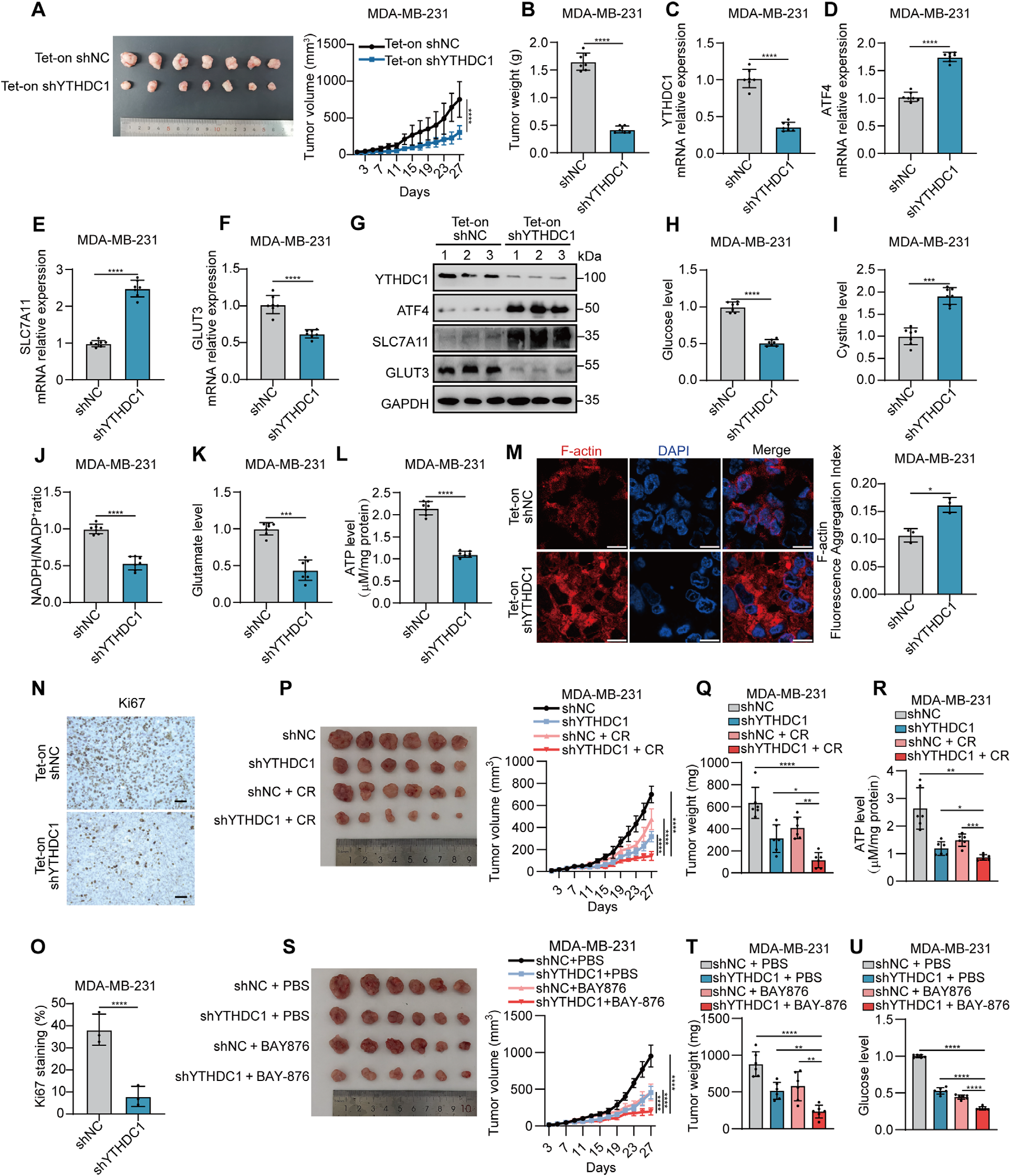
Fig. 4. YTHDC1 knockdown suppresses tumor growth and induces disulfidptosis in vivo. (A,B) YTHDC1 knockdown suppresses the growth of MDA-MB-231 xenografts in nude mice. 2 × 10⁶ MDA-MB-231 cells stably expressing Tet-on control or YTHDC1 shRNA were injected as xenografts in nude mice. Doxycycline (200 µg/ml) was supplied in drinking water to induce Tet-on shRNA expression. (C) Validation of YTHDC1 expression in xenograft tumors by RT-qPCR. (D–G) YTHDC1 knockdown upregulates ATF4 and SLC7A11, and downregulates GLUT3 at the mRNA (D–F) and protein level (G) in xenograft tumors. (H–J) YTHDC1 knockdown leads to decreased intracellular glucose (H), elevated cystine (I), and a reduced NADPH/NADP + ratio (J). (K,L) Measurement of intracellular glutamate (K) and ATP (L) levels in tumor tissues, showing significant depletion upon YTHDC1 knockdown. (M) Representative phalloidin staining shows increased F-actin contraction and aggregation upon YTHDC1 knockdow, as quantified by a significant increase in the Fluorescence Aggregation Index (FAI). Scale bars, 10 µm. (N,O) Immunohistochemistry of Ki67 in in YTHDC1 knockdown and control tumor tissues. Scale bars, 50 µm. (P–R) 30% Caloric restriction (CR) combined with YTHDC1 knockdown remarkably inhibits tumor growth of MDA-MB-231 xenografts in nude mice. Tumor image and tumor growth curves (P), tumor weights (Q) and intratumoral ATP levels (R). (S–U) Pharmacological glucose restriction using BAY-876 combined with YTHDC1 knockdown dramatically suppresses tumor growth of MDA-MB-231 xenografts in nude mice. Tumor image and tumor growth curves (S), tumor weights (T) and intratumoral glucose levels (U). For G, K, N, O, n = 3 mice per group. For AF, HJ, L, M, n = 7 mice per group. For PU, n = 6 mice per group. Each dot represents one mouse (A–U). Data are presented as mean ± SD (A–O, Q–R, T–U). For P and S, mean ± SEM are shown, and p values were determined using two-tailed Student’s t-test. ( p < 0.05, p < 0.01, p < 0.001, p < 0.0001).(图注取自PDF文本层,来源:Advanced Science, 2026)
Step 5:巧妙的转换——绕过 YTHDC1,直接递送 ATF4 mRNA 进行"治疗性过表达”
YTHDC1 在正常细胞中不可或缺,直接靶向毒性大。作者选择了一条更"聪明"的策略:既然 YTHDC1 敲低后,ATF4 上调是触发后续效应的关键,那把 ATF4 mRNA 直接送到肿瘤细胞里,不就能模拟 YTHDC1 敲低的后果了吗?
他们用脂聚合物纳米粒(LPNPs)包裹 ATF4 mRNA,直接胞质递送,完全绕开核内 YTHDC1 的 m6A 降解机制。效果出奇地好:NPs(ATF4) 递送效率远超质粒转染,甚至优于 m6A 突变体(A670G)质粒,因为突变体虽能抵抗 YTHDC1,但仍需入核。
在体内,瘤内注射 NPs(ATF4) 后,肿瘤中 ATF4/SLC7A11 表达升高,胱氨酸摄取↑、谷氨酸外排↑。
@方法论点评:“避开上游调控者,直接递送其下游效应分子的 mRNA"是一种巧妙的治疗策略。这样既模拟了靶向 YTHDC1 的代谢后果,又避开了全身性毒性。把 mRNA 直接递送胞质,绕开核内 m6A 调控,构成了"一个差异化优势”。
那这个"治疗性 ATF4 过表达"如何与药物联手,主动发动致命一击?
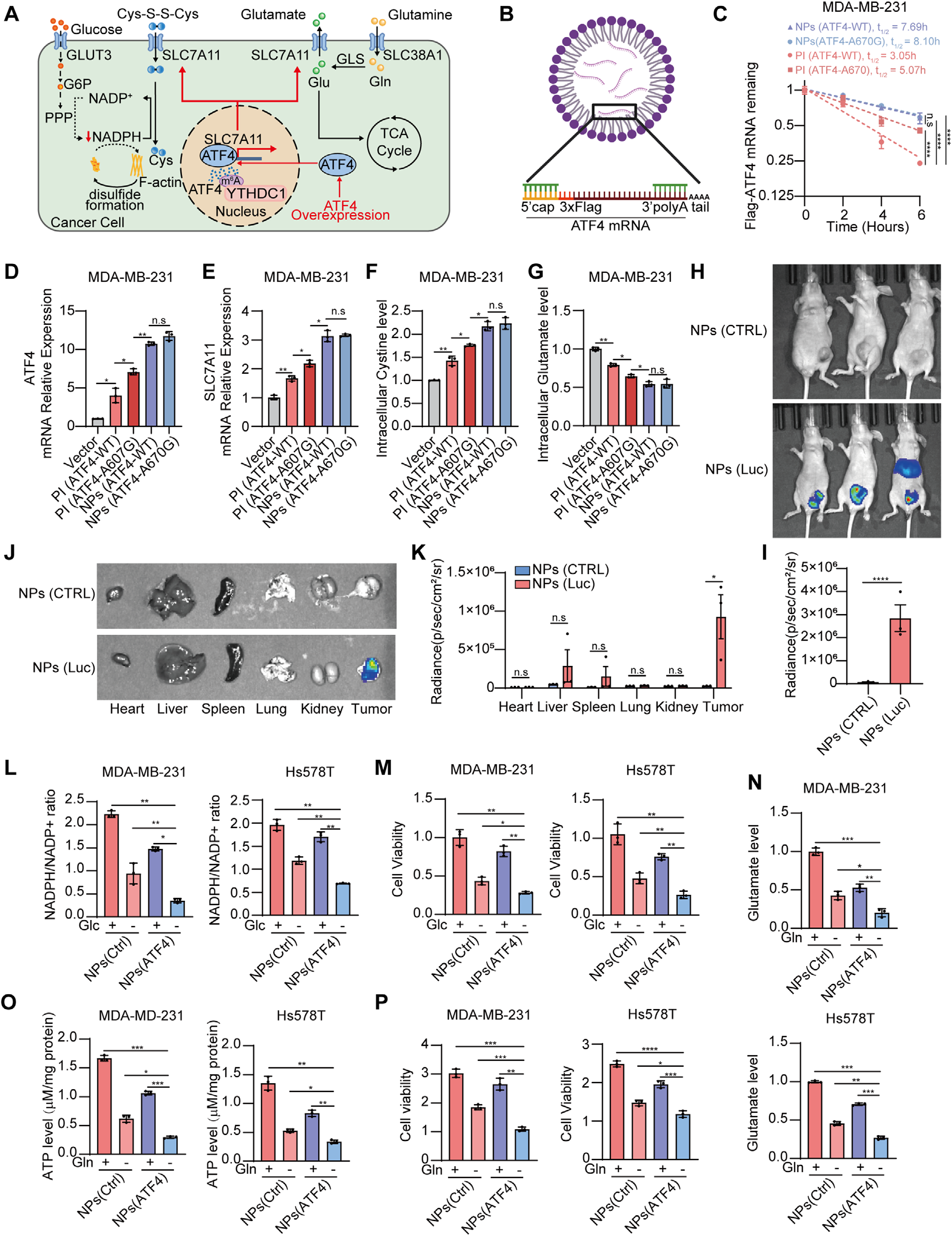
Fig. 5. ATF4 mRNA nanoparticle delivery effectively reprograms the metabolism of TNBC cells. (A) The working model indicates that ATF4 overexpression enhances SLC7A11-mediated cystine uptake and glutamate export, thereby sensitizing triple-negative breast cancer cells to glutamine and glucose deprivation. B, Schematic illustration of the preparation of lipid-polymer hybrid nanoparticles encapsulating ATF4 mRNA [NPs (ATF4-WT)]. (C) NPs delivered ATF4 mRNA is more stable than plasmid-transfected Flag-ATF4 mRNA (WT and A670G). (D–G) NPs (ATF4-WT) show higher ATF4 delivery efficiency (D), SLC7A11 expression (E), cystine uptake (F), and glutamate export (G) than plasmid-based approaches, while the NPs (ATF4- A6 70G) provide no additional advantage over NPs (ATF4-WT). (H) Representative in vivo bioluminescence images of live mice bearing MDA-MB-231 xenografts following intratumoral injection of mFLuc-loaded nanoparticles. (I) Quantification of total bioluminescence flux in tumors from the live mice shown in (H). (J) Representative bioluminescence images of tumors and major organs (heart, liver, spleen, lung, and kidney). (K) Quantitative analysis of(图注取自PDF文本层,来源:Advanced Science, 2026)
Step 6:两种联合方案——把 YTHDC1 的"防御"变成"自杀开关"
基于 YTHDC1 调控两条平行代谢通路的特性,作者设计了两种联用策略:
方案一:NPs(ATF4) + BAY-876(GLUT1/3 抑制剂)NPs(ATF4) 上调 SLC7A11,促进胱氨酸内流;BAY-876 阻断葡萄糖摄取,减少 NADPH 产生。双重打击下,胱氨酸堆积 + NADPH 耗竭,双硫死亡被强力诱导。体外和原位瘤模型均显示协同抑瘤,F-actin 聚集、Ki67 下降。 方案二:NPs(ATF4) + CB-839(GLS 抑制剂)NPs(ATF4) 上调 SLC7A11,促进谷氨酸外排;CB-839 阻断谷氨酰胺→谷氨酸的转化。两者叠加,细胞内谷氨酸被耗竭,ATP 骤降,细胞"饿死"。体内同样协同抑瘤。
@方法论点评:两种联用方案靶向同一枢纽分子调控的两条平行代谢通路,是"合成致死"逻辑的代谢版本。这是该研究从"基础发现→转化策略"的完整闭环,展示了代谢靶向组合疗法的精妙设计。

Fig. 6. NPs (ATF4) combined with GLUTs inhibitor BAY-876 synergistically induce disulfidptosis in vitro and in vivo. (A,B) Quantification of intracellular cystine levels (B) and glucose levels (C) in TNBC cells treated with PBS, NPs (ATF4), BAY-876, or combination therapy. (C) NPs (ATF4) combined with BAY-876 dramatically reduce NADPH/NADP+ ratio. (D) Representative phalloidin staining shows increased F-actin contraction and aggregation upon combination treatment, which is quantified by a significant increase in the Fluorescence Aggregation Index (FAI). Scale bars, 20 µm. (E) The images of MDA-MB-231 xenograft tumors in nude mice treated with PBS, NPs (ATF4), BAY-876, or combination therapy. (F,G) The combination of NPs (ATF4) and BAY-876 induces superior antitumor efficacy compared to monotherapies or PBS control. (H) Western blot showing enhanced ATF4 and SLC7A11 protein expression in the NPs (ATF4) treated tumors. (I–K) Combination treatment decreases intracellular glucose (I), elevates cystine levels (J), and reduces NADPH/NADP+ ratio (K). (L,M) Representative phalloidin staining shows increased F-actin contraction and aggregation upon(图注取自PDF文本层,来源:Advanced Science, 2026)

Fig. 7. NPs (ATF4) combined with glutaminase inhibitor CB-839 synergistically disrupts energy metabolism in vitro and in vivo. (A,B) Measurement of intracellular glutamate (A) and ATP (B) levels in TNBC cells treated with PBS, NPs (ATF4), CB-839, or their combination. (C) Cell viability assessment reveals that the combination of NPs (ATF4) and CB-839 exerts synergistic anti-proliferative effects, significantly surpassing the efficacy of either monotherapy. (D) The images of MDA-MB-231 xenograft tumors in nude mice treated with PBS, NPs (ATF4), CB-839, or combination therapy. (E,F) Growth curves and tumor weights show that the NPs (ATF4) and CB-839 combination achieves superior tumor suppression compared to single-agent treatments or PBS control. (G) Measurement of intratumoral glutamate levels demonstrates that combination treatment effectively depletes glutamate. (H) Measurement of ATP levels reveals that the combination therapy severely reduces cellular energy production in tumor tissues. (L) The working model illustrates that NPs (ATF4) enhance SLC7A11-mediated cystine uptake and glutamate export in TNBC cells. When combined with GLUT1/3 inhibitor BAY-876, glucose uptake and NADPH production are inhibited, which results in lethal disulfidptosis through redox imbalance. Another strategy is to combine with GLS inhibitor CB-839, which further deprives intracellular glutamate, severely limiting energy production and leading to cell death. Data are presented as mean ± SD of experimental triplicates (A–C). For (D–H), n = 6 mice per group. Each dot represents one mouse (G,I–K,M,O). p values were determined using two-tailed Student’s t-test ( p < 0.05, p < 0.01, p < 0.001, p < 0.0001).(图注取自PDF文本层,来源:Advanced Science, 2026)
核心结论
本研究揭示了 TNBC 中 m6A 阅读器 YTHDC1 的"代谢总指挥"角色:它通过 m6A 依赖的方式,稳定 GLUT3 mRNA保障糖摄取与 NADPH 生成,同时降解 ATF4 mRNA抑制 SLC7A11,防止胱氨酸超载和谷氨酸外泄,从而赋予 TNBC 细胞抵抗双硫死亡的生存优势。
基于此,作者开发了NPs(ATF4) mRNA 纳米药物,绕过核内 YTHDC1 调控,在胞质中强制过表达 ATF4,进而上调 SLC7A11。该策略可分别与GLUT 抑制剂 BAY-876或GLS 抑制剂 CB-839联用,从"葡萄糖-NADPH"或"谷氨酰胺-谷氨酸"两条线路协同攻击,诱导 TNBC 发生双硫死亡或代谢耗竭。为 TNBC 的代谢靶向治疗提供了新的组合策略。
对耐药/DTP/PGCC 的启示
代谢可塑性是 DTP 细胞生存的关键:DTP 细胞常依赖代谢重编程抵抗压力。YTHDC1 作为葡萄糖/谷氨酰胺代谢的枢纽,提示我们:靶向单个代谢通路往往无效,需同时打击多个代谢节点。YTHDC1 下游的 GLUT3 和 SLC7A11 联合干预,或可作为清除 DTP 细胞的策略。 “治疗性过表达"可能成为对抗 PGCC 的新思路:PGCC 具有极强的代谢适应能力。本研究提供的 ATF4 mRNA 纳米递送策略,通过主动制造"代谢困境”(双硫死亡或谷氨酸耗竭),或能有效清除 PGCC 及由其产生的耐药子代。 双硫死亡为耐药的 TNBC 提供新的"死亡开关":传统化疗多诱导凋亡,而耐药细胞常通过上调抗凋亡蛋白逃逸。双硫死亡是一种非凋亡性的、由代谢紊乱驱动的细胞死亡方式,有潜力绕过常规凋亡耐药机制。YTHDC1 调控网络为触发这一死亡方式提供了明确的分子靶点。
局限
动物模型仅使用细胞系异种移植(CDX),未在患者来源异种移植(PDX)模型中验证,临床转化的可靠性尚有不足。 未深入探讨 YTHDC1 在 TNBC 中特异性高表达的上游机制(如拷贝数扩增、转录因子激活等)。 NPs(ATF4) 的瘤内注射给药方式在临床应用中可操作性有限,静脉给药后的靶向分布与安全性仍需进一步优化。 文中未阐明 YTHDC1 对 ATF4 和 GLUT3 的 mRNA 稳定性调控是否存在细胞应激或营养状态依赖的"开关机制"。
来源
期刊:Advanced Science,2026 年。DOI: 10.1002/advs.77492